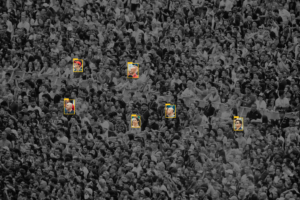

Football fans and revellers from across the globe have congregated in Canada, Mexico, and the United States to experience the 2026 FIFA Men’s World Cup. The event is marked by several firsts: three host nations, more participating teams, demand-based ticket pricing, and a sprawling ecosystem of AI and surveillance tech deployed at a larger scale than in any previous sporting event. The tournament follows an established trend of increasing pervasive surveillance at mega-events and keeping it in place indefinitely.
A new report by Ranking Digital Rights (RDR) shines a light on the role of technology companies and their products in building the extensive surveillance stack of the 2026 Men’s FIFA World Cup. It follows a three-part series titled Red Card on Digital Rights, born of a partnership between RDR and SMEX, which investigated the state of the internet and digital surveillance at the 2022 Men’s World Cup in Qatar.
Our report, titled No Fair Play: Mapping the 2026 World Cup Surveillance Stack, exposes the hidden layers of surveillance technologies and calls attention to the lack of robust safeguards around them. We found that:
- The 16 host cities augmented their monitoring and tracking capabilities ahead of the tournament, with the help of at least 21 companies. Surveillance infrastructure already existed at many of the event venues, typically in the form of video cameras. But at least 21 companies—from Axon to Palantir—have directly or indirectly supported the buildout of the 2026 World Cup surveillance stack. All but six of these companies won new contracts specifically for the tournament.
- These vendors’ products and services comprise a five-layer surveillance stack that includes data harvesting at scale, predictive policing, communications interception, data integration and command centers, and aerial surveillance. The offerings within the stack range from facial recognition systems to automated license plate readers (ALPRs), closed circuit television (CCTV), drones, behavioral analysis, and data integration services. Edge computing and AI systems were built into this stack as infrastructure, carrying the risk of amplifying bias, and compounding the human rights harms that all these products and services were already associated with.
- Companies, governments and FIFA did not establish strong enough due diligence, risk mitigation, and remedy mechanisms for the tournament and beyond. Such mechanisms should clearly consider the risks of privacy breaches, discrimination, and other human rights violations stemming from the deployment of a vast surveillance stack, both in the immediate term and in the years to come.
- The FIFA-mandated human rights actions plans for each host city are severely lacking in consideration for human rights impacts arising from the use of technology, especially those derived from surveillance and data protection risks. Most of these plans were published too close to the opening game to invite meaningful feedback. Only Vancouver’s action plan clearly indicates that the surveillance technology deployed for the tournament will be dismantled after a specified period.
- The 2026 World Cup follows a dangerous trend set by similar mega sporting events: a dramatic expansion of surveillance tech with insufficient safeguards for marginalized communities. In Brazil, the equipment acquired for the 2014 Men’s World Cup remains in use, and its command centers were absorbed into policing structures. In France, extraordinary surveillance policies and measures were adopted ahead of the 2024 Olympic and Paralympic Games. In Qatar, biometric systems remain operational years after the country hosted the 2022 Men’s World Cup. And in South Africa, the 2010 Men’s World Cup was the catalyst for the massive proliferation of surveillance cameras that remain active to this day.
When combined with the increasing use of video surveillance, facial recognition technology and behavioral analytics, the normalization of tech-facilitated surveillance through mega-events becomes evident. Our research highlights the impact that the prevalence of this technology is having on the way people exercise and enjoy their right to privacy, freedom of expression, and peaceful assembly.
Activists and civil society have come together to push back against the rampant deployment of surveillance at giant sporting events and the tapestry of failures that accompany it, including labor abuses and housing exploitation. Coordination and community building is taking place at the international, national, and local levels. Hackers and digital rights organizations are sharing increasingly creative ways to circumvent the surveillance stack. Our report celebrates these efforts to reject the normalization of the panopticon.
This new report serves as a reminder that the momentum built by those resisting AI-powered surveillance will not end with the final whistle. We believe the spirit of activism will only grow stronger as we look to the next global mega-event: the 2028 Olympic and Paralympic Games in Los Angeles. Human rights advocates will carry the lessons from this World Cup—combined with experience from previous Olympic Games—to shape campaigns calling on governments, companies, and other players to address the pressing needs of vulnerable communities instead of investing in a permaculture of surveillance.