09 Oct The RADAR: We’ve got our eyes on Apple
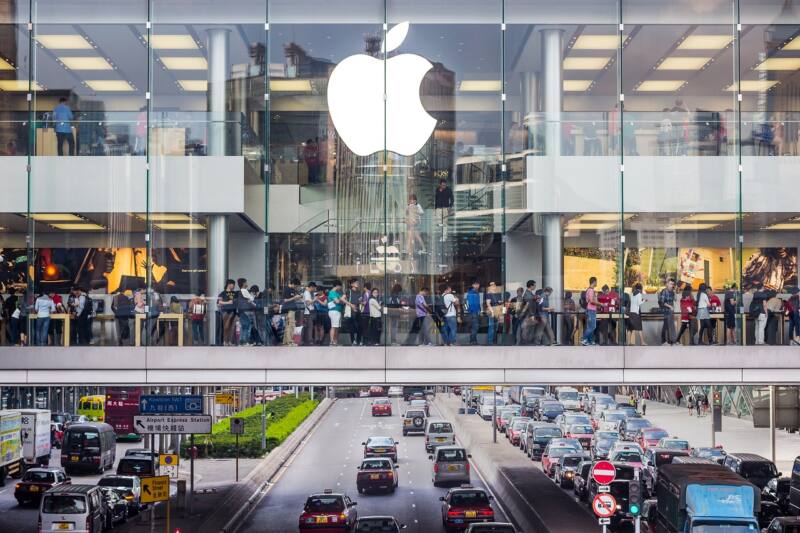
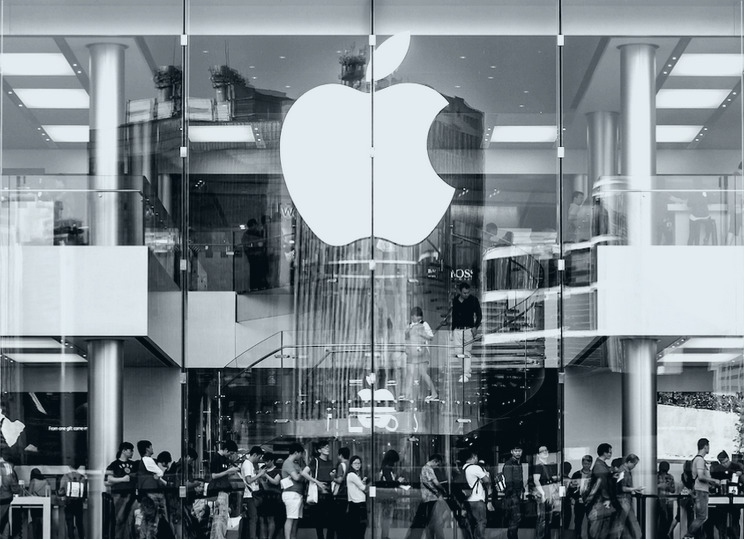
The Apple Store in Hong Kong. Photo by Robert Pastryk via Pixabay, labeled for reuse.
This is the RADAR, Ranking Digital Rights’ bi-monthly newsletter. This edition was sent on October 9, 2020. Subscribe here to get The RADAR by email.
As the U.S. general election approaches, digital disinformation and targeted political ads are fueling debates among policymakers and politicians of all stripes.
At RDR, we’re looking closely at what drives these things—chiefly, big tech companies’ pervasive collection of user data. While Facebook and Google are front and center in the public conversation, they aren’t the only players deciding the fate of our digital data.
For iOS users, Apple holds plenty of power too. We were heartened this past summer when the company announced plans to roll out a suite of anti-tracking measures for iOS 14, marking a big win for user privacy. The widespread corporate practice of tracking users’ online activity without their informed consent violates the fundamental human right to privacy, and enables data-driven discrimination.
But soon thereafter, app developers and major companies—Facebook among them—began complaining that the changes would put a dent in their advertising revenues. In September, Apple decided to postpone the changes until 2021, leaving iOS users vulnerable to tracking during this critical time.
This week, we published a joint letter urging Apple CEO Tim Cook to implement the anti-tracking measures immediately. Human Rights Watch, Amnesty International, the Electronic Frontier Foundation, and other leading NGOs were among the signatories. We closed the letter arguing that “implementing and fully enforcing this policy would position Apple as a standard-setter in the industry.”
And we know that Apple wants to be exactly that. In September, the company made headlines with its first-ever explicit commitment to uphold human rights across its operations, from policies for users to its hardware supply chain. This was big news, especially coming from the most valuable publicly traded company in the world. But it has been a long time coming!
For three years, our researchers have been sounding the alarm on Apple’s failures in this realm. While it has taken some steps to build and publish policies on privacy and security, the company had never committed to upholding freedom of expression, until now. This is why Apple has ranked last among U.S. companies evaluated in the RDR Index every year since 2017.
The downstream effects of these decisions have had real consequences for users, especially in greater China, where hundreds of apps —including apps for the New York Times, Quartz, and a Hong Kong protest-mapping app—have been censored from the App Store. Despite strong media coverage and public condemnation, the company has never published its policies governing App Store (or other content) removals, or met other key human rights benchmarks in this area.
Alongside RDR, other NGOs and even shareholders have been pushing to change this. In February 2020, the UK-based advocacy group SumofUs helped to organize and put forth a shareholder resolution—citing RDR’s 2019 evaluation of Apple—that would have required Apple’s board of directors to report annually on the company’s policies on freedom of expression and access to information. The measure was defeated but received more than 40 percent of votes cast, effectively putting the company on notice.
The Financial Times described the resolution as a major driver of Apple’s new human rights policy, and also mentioned RDR’s role in the change. All told, these forces—big public reactions to censorship, impact-oriented policy research, civil society advocacy, and shareholder pressure—came together and pushed Apple to change its ways. This is our theory of change in action.
The company’s published policy committing to uphold human rights is a huge measure of progress. But the strongest test of this commitment will be Apple’s actions moving forward.

RDR Director Jessica Dheere. Photo by Dan Jones.
Leadership transition: Changes are happening at RDR!
Jessica Dheere was promoted to director from deputy director in September 2020. Rebecca MacKinnon will stay on as founding director into 2021.
“I’m both honored and excited to carry this vision forward with our remarkable team,” Dheere said in New America’s official announcement. “We see 2021-22 as a time for us to bring our rich body of research and policy recommendations to bear as technology companies continue to play a pivotal role in the protection of human rights, civil liberties, free and fair elections, and democratic institutions.”
Write to her at dheere@rankingdigitalrights.org and follow her on Twitter at @jessdheere.
Fall 2020 Investor Update: Geopolitical risks are rising—and regulation is coming
Hot off the presses this week is our Fall 2020 Investor Update, which gives investors a close look at key digital rights concerns and questions to ask in 2021. This edition highlights proposals from shareholders at Apple, Facebook, and Alphabet that addressed digital rights issues—there were 12 of these in 2020, including four that cited 2019 RDR Index findings. It also looks at Facebook’s business model and the recent #StopHateForProfit ad boycott, Twitter’s summer security breach, and the unique risks that foreign companies face when operating in China.
Our take on Trump’s attempt to ban TikTok and WeChat
The administration’s executive orders banning Chinese-owned platforms, and other policies that would have the effect of carving up the internet along national borders, are no way to protect users’ security or other human rights. In an interview with Forbes, RDR Founding Director Rebecca MacKinnon compared Trump’s efforts to China’s internet censorship regime, the so-called “Great Firewall.”
Prior to the September rulings by federal judges blocking Trump’s TikTok and WeChat bans on First Amendment grounds, we urged both Google and Apple—whose app stores control access to both apps—to push back against the order. After all, both companies publicly commit to conducting due diligence on government demands to censor content, and to resisting overly broad demands like these.
But it’s not all bad. In an opinion piece for Slate, MacKinnon offered some reassurance (she says it’s not too late to save the internet!) and concrete solutions to these problems, starting with strong laws protecting privacy and mandating corporate transparency.
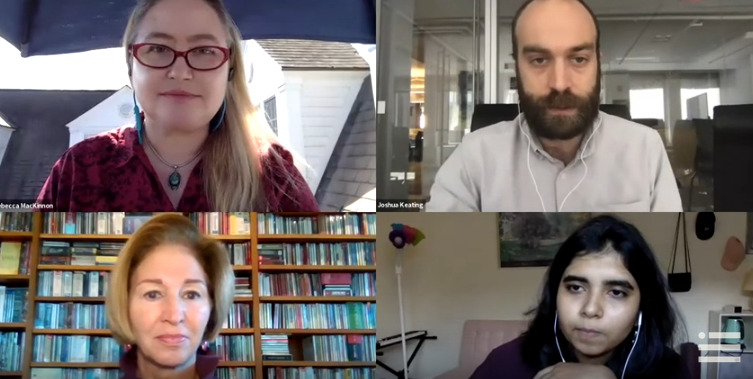
So Long Internet, Hello Internets: Rebecca MacKinnon, Ann Marie Slaughter, Madhulika Srikumar, and Joshua Keating discussed the #DividedInternet at a virtual event hosted by New America and Slate’s Future Tense project.
Protests, network shutdowns, and our call for transparency at Africa’s largest telco
Protest movements sometimes inspire governments—like that of Alexander Lukashenko in Belarus—to shut down social media platforms, in hopes of quelling demonstrations. But do these shutdowns actually achieve the desired effect?
“Rarely do we actually see a shutdown being followed by a complete drop-off in the number of protests,” said RDR Company Engagement Lead Jan Rydzak, in a VICE interview about a report he recently co-authored. “It’s about creating an atmosphere of fear and uncertainty,” he told VICE. When shutdowns do happen, telcos are usually the ones to pull the plug. In these situations arise, RDR pushes companies to explain the circumstances under which they shut down or restrict access to the network.
In South Africa, Ralph Mupita recently became the new CEO of telecommunications giant MTN, which serves more than 20 countries in Africa and the Middle East. RDR joined a coalition letter to Mupita that highlighted MTN’s poor performance in the RDR Corporate Accountability Index, due in part to the company’s role in facilitating government-mandated internet shutdowns. The letter, alongside an op-ed for Business Day, by Access Now’s Berhan Taye, urges Mupita to make good on the company’s human rights commitments by improving transparency and engagement with civil society.
Ad transparency is vital to democracy: Our submissions to the DSA
Since our last edition, we’ve made two contributions to the European Commission’s public consultation on the Digital Services Act (DSA)—a forthcoming package of rules that will address the legal responsibilities of platforms regarding user content, ads, and more. In our solo submission, we called for universal transparency by default for all online ads. And in a joint submission with Global Partners Digital, we voiced concern that certain aspects of the DSA pose a risk to individuals’ digital rights and are inconsistent with EU member states’ international human rights obligations.
The scan: What we’re reading
The summer culminated with two knockout stories citing leaked internal communications from Facebook confirming widespread suspicions—and our own research findings—that Facebook’s approach to addressing users’ grievances needs work. The Verge offered a trove of comments from company-wide discussions, exhibiting employee concerns about Facebook’s content moderation practices, among other things.
BuzzFeed exposed a 6,600-word memo from fired Facebook data scientist Sophie Zhang, who wrote that in reviewing problematic content from around the world, she had “made decisions that affected national presidents without oversight, and taken action to enforce against so many prominent politicians globally that I’ve lost count…”
Final pings
- Read this new research report by RDR Founding Director Rebecca MacKinnon, published by the National Center for Free Speech and Civic Engagement at UC Irvine: Reclaiming Free Speech for Democracy and Human Rights in a Digitally Networked World
- RDR is a member of the new Global Internet Freedom Consortium.
- Are You a Surveillance Capitalist? RDR’s Nathalie Maréchal will join this panel discussion at Business for Social Responsibility’s “Meet the Moment, Build the Future” conference on October 20. Register here.