RDR is now an independent initiative. Our website is catching up.  Read our announcement →

As we settle into the new year, RDR and its Index continue to make the news.

Rebecca MacKinnon wrote an op-ed for CNN arguing that as technology companies face greater pressure to monitor and censor communication, we risk losing the ability to use such platforms for social justice, activism, and journalism. Priya Kumar wrote the lead article for the January 28th edition of New America Weekly, which describes how RDR’s Index helps foster greater corporate accountability among ICT companies. And in a piece for Slate, Priya drew on the latest academic research and the Index results to highlight what’s lacking from company privacy policies. Nathalie Maréchal wrote a paper about RDR for a special issue of The Fibreculture Journal focused on activism and technology.

PRI-screenshot

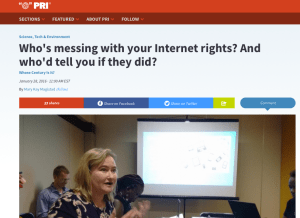
Screenshot of Public Radio International’s story on digital rights

Other media outlets and advocacy organizations continued to interview RDR team members and draw on the Index results. Rebecca MacKinnon was quoted in an Atlantic article about American Internet companies doing business in China. The Public Radio International program, “Whose Century Is it?” did a piece on digital rights that highlighted Rebecca’s work in the space, including RDR. An interview with Rebecca (conducted two years ago) was featured in the documentary Facebookistan, released late last year. The film focuses on efforts to get companies such as Facebook to respect users’ rights to freedom of expression and privacy. The title comes from a term Rebecca coined in her book, “Consent of the Networked.” The civic news outlet CivSource quoted Rebecca about an open letter signed by more than 170 organizations and individuals in support of strong encryption. And in a blog post about Internet shutdowns in Egypt and Morocco, AccessNow cited Etisalat’s poor performance in RDR’s Index.

Since its release in early November, the Ranking Digital Rights inaugural Corporate Accountability Index has received worldwide media attention, demonstrating global interest in corporate respect for users’ rights.

In coordination with the launch of the Index on November 3rd, The Guardian newspaper published two in-depth analyses of the Index data and its implications:

Rebecca MacKinnon discussed RDR's Index on the Wall Street Journal's Opinion Journal channel. Screenshot via Opinion Journal

Screenshot of Rebecca MacKinnon discussing RDR’s Index on the Wall Street Journal’s Opinion Journal channel.

The RDR team has been interviewed and invited to write pieces about the Index. Rebecca MacKinnon discussed the findings on the Wall Street Journal’s Opinion Journal channel and with Deutsche Welle. Priya Kumar talked about the Index on the Digital Show on Sirius XM’s Wharton Business Radio channel. Allon Bar wrote about the Index in a guest post for the Measuring Business and Human Rights project, based at the London School of Economics. He also talked about the results on the German Info-radio.

In addition, news about RDR’s Index and its findings appeared in NBC News, Fast Company, Ars Technica, Bloomberg Brief, Fortune, SFGate, TechWeek Europe, Hacked, WNYC, Information Week, CXO Today, IT ProPortal, WebProNews, Beta News, SC Magazine, TechWorm and Digit (India).

An Agence France-Presse story about the Index was syndicated around the world, including The Times of India, The Economic Times (India), Malay Mail Online, The Malaysian Insider, Free Malaysia Today, The Star (Malaysia) The Business Times (Singapore), The Bangkok Post, The Manila Times, Interaksyon (The Philippines) The Peninsula (Qatar), The Citizen (South Africa), France24, and Le Figaro (in French). International outlets also covered the story: la Repubblica (in Italian), Süddeutsche Zeitung and Taz (both in German) and NU.nl and WebWereld (both in Dutch). The Institute for Human Rights and Business, Article 19 and the Committee to Protect Journalists wrote about the Index.

Media are already using RDR’s Index to provide context when discussing digital rights issues. The Pakistani newspaper Dawn referenced the Index results in a story about Facebook’s updated transparency report. ThinkProgress highlighted the Index in an explanation of how the U.S. Congress struggles to craft cybersecurity legislation that respects individual privacy rights. OpenDemocracy underlined RDR’s findings in its argument that technology companies endanger their reputations by ignoring digital rights. Another post on the LSE’s Measuring Business and Human Rights project blog explains how rankings such as RDR’s Index can spur company action.

Stay tuned for more from the RDR team in the coming weeks and months!

YouTube video of 2015 IGF RDR/Internews session on Using the Corporate Accountability Index for Research and Advocacy

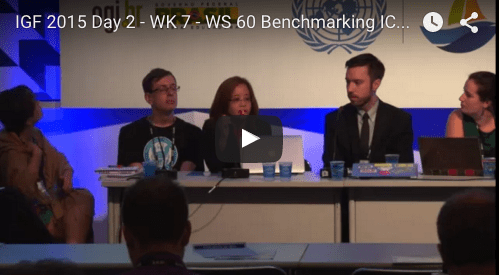
YouTube video of 2015 IGF workshop Benchmarking ICT companies on digital rights

After a series of launch events in the U.S., the RDR Corporate Accountability Index took to the global stage earlier this month as members of the RDR team presented the Index’s results at the Internet Governance Forum, an opportunity to engage with civil society advocates, researchers, government officials and private sector representatives from around the world. We received feedback on the project, and brainstormed about future activities with potential partners and collaborators

Reactions to the Index were positive. Several people commented on the painstakingly detailed approach to data collection and analysis. This is data one can stand behind. Most of the critiques could be summarized as “do more of the same… much, much more.” More companies, more services, in more markets… which of course requires more resources than the project currently possesses, but we are working on it…

Another common concern is that the Index measures disclosed policies and practices but does not take the next step to verify whether companies are actually carrying out the policies and practices that they describe. We also lack the resources to do such work, which would require on-the-ground staff in many countries. Instead, we welcome researchers and advocates to develop projects that would carry out the verification work in a globally distributed way: it would be ideal if a multitude of advocacy groups and academic institutions could develop their own approaches to verify and track how companies’ policies and practices are actually experienced by users in different parts of the world.

We also learned more about similar yet complementary projects that approach the same issue — corporate responsibility to respect human rights online — from different angles. If this ecosystem can seem like a messy patchwork at first glance, the conversations that RDR participated in highlighted the importance of collaboration between projects. As Carolina Botero, of Colombia’s Fundación Karisma, shared during our Day 2 workshop, being able to tell representatives from domestic Internet service providers that transparency reporting is now a standard practice that global giants like Google and Facebook routinely engage in was key in changing the tone of the conversation, which had been rather confrontational until then.

Day 0: Brainstorming Session

On “Day 0” of the conference devoted to self-organized events by conference attendees, RDR and Internews held a research and advocacy brainstorming session around the newly released Corporate Accountability Index. What additional research projects could emerge from the Index data, and how can the Index support advocacy?

Following opening remarks by David Kaye, the UN’s Special Rapporteur on Freedom of Expression, and a presentation of the Corporate Accountability Index, the Ranking Digital Rights team engaged the participants in a wide-ranging discussion of the Index, its potential for both research and advocacy, and also its limitations.

Participants rightly pointed out that while this evaluation of 16 companies is a commendable start, future iterations of the Index (ideally on an annual basis) will have greater impact if they include a wider range of companies, including more of the companies’ direct competitors. This, of course, is contingent on a combination of successful fundraising and on forging partnerships with civil society groups around the world. All of Ranking Digital Rights materials’, including our methodology and research guidance, are freely available under Creative Commons licensing, and we encourage our colleagues in the digital rights space to consider applying the RDR criteria to a wider range of companies and subsidiaries, for example by doing regional or country-specific rankings.

A thornier limitation is that because it only evaluates publicly available information (for reasons documented here), the Index cannot address the issue of company practices that diverge from their stated commitments. While there is a clear need to highlight this kind of disparity where it exists, our research has revealed that it is much more common for companies to simply not have a policy in place, or to have a an internal policy that users and the general public have no access to. We believe that RDR can best promote greater corporate accountability for human rights by incentivizing companies to develop and make public policies surrounding commitment to human rights, privacy and freedom and expression. Once companies make public commitments and disclosures, it is then possible for stakeholders to hold them accountable by verifying that they are living up to their commitments and actually adhering to their own stated policies. One project aiming to highlight companies’ actual practices is the recently launched OnlineCensorship.org, where users are able to submit their experiences with content takedown and other online censorship. Lumen (formerly Chilling Effects) allows users to upload information about take-down requests and receive information about their legal rights.

Day 2: Benchmarking ICT companies on digital rights

On Day 2 of the IGF, Rebecca MacKinnon participated in a roundtable workshop on “Benchmarking ICT companies on digital rights,” which I moderated. The participants’ experiences point to the diversity of strategies that can be effective in getting companies to improve their respect for digital rights: from star-based ratings like the EFF’s Who Has Your Back? and Fundación Karisma’s ¿Dónde están mis datos? to the RDR Index’s granular scoring system, there is more than one way to encourage ICT companies to respect human rights. The Transparency Reporting Index maintained by Access Now is formidable resource for activists from a wide variety of subsectors, providing links and brief descriptions for the transparency reports of more than 50 global companies. The Terms of Service & Human Rights project translates the “legalese” that these documents are usually written in into plain language that users can understand, thus empowering them to make informed decisions about the services they use. It is clear that these projects, and others, rely on and support one another. All human rights advocacy is an ecosystem to an extent, but this is all the more true when we’re dealing with multinational corporations whose actions impact users all over the world in different but related ways.

Comments by Cecille Soria of Democracy.Net.PH and Kelly Kim of Open Net Korea reinforced the importance of starting with a low bar and raising it gradually. While both Democracy.Net.PH and Open Net Korea would eventually like to start ranking projects using the RDR criteria, the reality is that many companies in their respective countries do not currently provide the kind of information that the Index’s methodology seeks to surface. Even though the South Korean company Kakao stood out for its relatively robust disclosures in the RDR Index, Kim said Korean companies still have considerable progress to make. Open Net Korea plans to focus on getting companies to publish regular transparency reports before scrutinizing the contents of those reports. This echoed the earlier comments from the EFF’s Jeremy Malcolm, who noted that the Who Has Your Back? report has gradually raised the bar for the companies it evaluates.

This year Ranking Digital Rights has a strong presence at the Internet Governance Forum, being held this coming week in João Pessoa, Brazil. We will be presenting the results of the Corporate Accountability Index and also engaging in broader discussions about standards for government and industry related to human rights and the Internet. An interactive schedule for the entire conference can be found here.

We are organizing two events:

Monday November 9, 2-6pm, Workshop Room 8 –  “Day Zero” workshop: Corporate Accountability for Digital Rights: Building a Global Research and Advocacy Network.

UPDATE: The UN Special Rapporteur on Freedom of Expression, David Kaye, will deliver opening remarks

This will be an in-depth meeting to brainstorm ideas for how civil society groups and academic researchers can use the Corporate Accountability Index data and indicators for their own research and advocacy at national, regional, and global levels. Click here for more details about location and agenda, and to RSVP.

Wednesday November 11, 11am-12:30pm, Workshop Room 7 –  Workshop: Benchmarking ICT Companies on Digital Rights. (Click here for remote participation information)

Session description: There has been growing interest over the past few years in civil society efforts to hold ICT companies accountable for their impact on human rights,. All stakeholders including companies have an interest in setting clear industry standards on dimensions of privacy and freedom of expression. To that end, more research and comparative data about different companies’ policies and practices can encourage companies to compete with one another on respect for users’ rights. Given the international scope and complexity of the sector, this task is more than any single organization can fully tackle on a global scale, and it is important to recognize the diversity of goals and perspectives represented by organizations working in this space. The purpose of this roundtable workshop is to bring together a geographically diverse range of NGO’s and researchers to share experiences and perspectives on creating projects to rank or rate ICT companies. The goal is to create a “how to” guide on launching such projects as well as a collaborative network of organizations and researchers. Company and government stakeholders will also provide feedback on how such projects can most effectively influence corporate practice and government policy.

Click here for updated session info and list of participants.

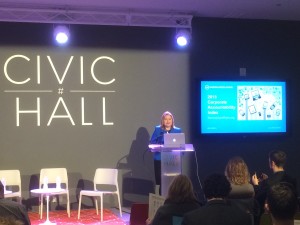
At Tuesday’s launch event for the Ranking Digital Rights Corporate Accountability Index, project director Rebecca MacKinnon presented the Index’s findings and joined a panel discussion with Peter Micek, global policy and legal counsel at Access Now, and Ellery Biddle, director of Global Voices Advocacy. Moderating the discussion was Micah Sifry, co-founder and executive director of Civic Hall.

RDR-NYC-Launch

Rebecca MacKinnon presents the findings of the inaugural Corporate Accountability Index. Click the image to view a webcast of the event, courtesy of Joly MacFie and the Internet Society. Image: Priya Kumar

“The top-scoring company is only 65 percent. So if this were a test, they’d be getting a D in school.” MacKinnon said, “But…this is a diagnostic test; this is not a certification. This is a test you take at the start of the class to figure out where everybody stands, and then we can all get to work and figure out how we can all improve.”

By evaluating the extent to which companies are being open and clear about their policies and processes that affect users’ freedom of expression and privacy, the Corporate Accountability Index serves as a starting point for conversations about how to foster an Internet that is compatible with human rights.

What’s at stake here? Biddle described how the Global Voices community, which includes writers and bloggers from around the world, established a project focused on online free expression after realizing how government and corporate actions were threatening their work.

“Our blogs started being blocked. People started receiving different kinds of threats because of what they were writing online. Legal measures were taken against them,” Biddle said of Global Voices contributors. “So this [Index] speaks to a lot of issues that we’ve dealt with quite personally.”

People around the world rely on communications networks and platforms for far more than work. “Increasingly, our daily lives are forced online,” Micek said. “Our rights are mediated by these platforms, and our access to human rights depend[s] on their policies and on the decisions made, often far, far away.”

Last month, Micek’s organization, Access Now, received reports that access to mobile Internet and SMS had been shut down in Congo-Brazzaville around the time of a mass demonstration to oppose a proposal to extend presidential term limits. This was the fifteenth reported shutdown Access Now identified this year, Micek said. Such actions are dangerous, Micek explained, because they prevent users from telling each other, “Hey, don’t go down that street, the troops are assembled here; protest elsewhere.”

And yet, companies hardly disclose information about the types of demands they receive to shut down access to networks, which makes it nearly impossible for users to understand when or why the networks upon which they depend may be inaccessible. This example highlights the importance of corporate disclosure in ensuring that digital technologies and platforms align with human rights.

The panelists highlighted several steps companies can take to improve their respect for users’ free expression and privacy. These include:

  • Explain how they handle private requests to restrict content or obtain user data.
  • Disclose more information about how they determine whether to remove content that other users have flagged.
  • Implement encryption measures that keep user data private.

In addition, NGOs, activists, and researchers can use the Index data and methodology to dig deeper, for example, by ranking additional companies within a particular country or by comparing how the actions of the companies ranked in the Index compare with their commitments and disclosures.

Companies are only one actor within the digital ecosystem, but they play a critical role in ensuring that the use of digital tools doesn’t mean giving up on human rights. This Index of companies was published just one week after Freedom House released the Freedom on the Net Index, which found that Internet freedom around the world has declined for the fifth straight year in a row.

“We’re at this crossroads right now,” MacKinnon said. “Companies can be part of the problem…or at least some critical mass of them can be part of the solution…They need to be part of the solution. And they’re going to have to think creatively and innovatively. These are some of the most innovative companies on Earth. Let’s get to work with some innovation here.”

A webcast of the event is available here. Many thanks to Joly MacFie and the Internet Society for running and sponsoring the webcast.