RDR is now an independent initiative. Our website is catching up.  Read our announcement →

Twitter under pressure. Photo by Quinn Dombrowski (CC-BY-SA-2.0)

Twitter under pressure. Photo by Quinn Dombrowski (CC-BY-SA-2.0)

This is the RADAR, Ranking Digital Rights’ newsletter. This special edition was sent on Jun 17, 2021. Subscribe here to get The RADAR by email.

US-based tech companies have long vowed to enforce their own content and data-collection rules, while also following the “law of the land” in every country where they operate. With the exceptions of countries that block their services altogether, this approach has allowed tech giants to remain accessible in most places, most of the time. But with powerful political actors worldwide increasingly using social media platforms to disseminate their views (whether fact or fiction) and occasionally running afoul of platform rules, this delicate balance of interests is being tested.

Recent events in both India and Nigeria have shown how company efforts to reduce disinformation and harmful speech on their platforms—paired with their relative lack of transparency in showing how they enforce content rules—can put their business operations at risk.

India’s new IT Rules, passed in February 2021, require “significant social media intermediaries” like Google and Facebook to introduce new measures on issues ranging from end-to-end encryption to locally-staffed grievance programs for content removal and related disputes.

While Facebook and Google both took measures to comply with the new rules before they went into force, Twitter held out. But after Indian security authorities came to Twitter’s offices in Delhi and Gurgaon, seeking to investigate Twitter’s decision to label a tweet (sent by a BJP party official) as “manipulated media,” the company vowed at the eleventh hour that it would “strive to comply with applicable law in India.” Read the Software Freedom Law Centre’s analysis of the 2021 IT Rules.

Meanwhile in Nigeria, Twitter removed a tweet from the official account of President Muhammadu Buhari that contained a veiled threat against Igbo people, who represent the third largest ethnic group in the country. The next day, Twitter was blocked nationwide and officials threatened to arrest anyone using the service via VPN.

Our colleagues at Paradigm Initiative have called out their government for violating Nigerians’ rights to freedom of expression, which are protected under both local and international law. They also have vowed to keep tweeting.

In both contexts, these dynamics beg critical questions: To what extent do companies actually follow local laws? And to what extent are they enforcing their own policies, in every country where they operate? Without robust transparency mechanisms, it’s hard to know.

Year after year, our research has shown that all the companies in the RDR Index have significant work to do when it comes to detailed transparency reporting on content policy enforcement and building robust remedy and appeal mechanisms for people wishing to contest a company’s decisions. Visit the 2020 RDR Index site to see our most recent findings.

TikTok is on the tightrope too—and we’re checking it out

In the US last week, President Biden revoked three Trump-era executive orders that attempted to ban both TikTok and WeChat (among other services) on national security grounds. Biden then introduced a new order that will set in motion a “rigorous, evidence-based analysis” of certain software products owned by foreign adversaries “that may pose an unacceptable risk to U.S. national security.”

The move puts TikTok back in the spotlight in Washington, and re-raises questions about whether the service’s 100+ million users in the US should be concerned about the company’s data privacy and security practices, given that its roots are in China.

This past spring, we’ve been digging into TikTok’s policies and practices in an effort to answer some of these questions, and explore others. Stay tuned for our findings, out in just a few weeks! If you’re curious to learn more, or to share your own insights on the company, get in touch.

Hey Big Tech, don’t leave us hanging

What’s one thing each company can do to improve its human rights record? In mid-May, we launched our annual joint campaign with Access Now and the Business and Human Rights Resource Center to pressure each of the 26 companies in the RDR Index to make one, single change to their policies or practices. Read our recommendations

So far, only three companies have responded: Kakao, Vodafone, and Verizon Media (owner of Yahoo mail). For the 23 other companies we wrote to, we can only assume that they’ve decided users’ human rights are not a high priority. We hope they’ll prove us wrong in the days to come.

Other campaigns we’re supporting:

  • The Electronic Privacy Information Center is urging the Biden Administration to ensure that any new transatlantic data transfer deal will be coupled with legislation that reforms government surveillance practices and guarantees privacy. Read the letter.
  • The Electronic Frontier Foundation is calling on Venmo and Paypal to publish regular transparency reports and provide meaningful notice to users before restricting their accounts. Read the letter.
  • We also joined 175 civil society organizations, technologists, and experts to call for a global ban on biometric recognition technologies that can be used to identify and track people worldwide.

Celebrate Pride month with GLAAD’s Social Media Safety Index

We are proud to promote GLAAD’s first-ever baseline evaluation of the LGBTQ user safety experience across the social media landscape. This comprehensive new report compares key safety and security features of Facebook, Instagram, Twitter, YouTube, and TikTok, drawing heavily on our indicators and 2020 RDR Index findings. Read the report.

RDR media hits

Politico: RDR Projects Director Ellery Biddle was quoted in a story about Google’s new agreement to build a cloud region in Israel, and how this might affect people’s rights, particularly Palestinians and Arab Israelis. “We’re pushing [Google] to be as transparent as possible about what they’re agreeing to do, how they’re going to treat peoples’ data, [and] what kinds of protections and due process mechanisms are in place to protect peoples’ privacy,” she said. Read via Politico

Digital Privacy News: Commenting on Google’s new approach to user data collection, RDR Senior Policy and Partnerships Manager Nathalie Maréchal said, “[Tech companies] have been making unfathomable amounts of money from monetizing data about internet users and selling advertising against it…They see that regulation is coming — and they’re hoping that by reforming their business a little bit, they’ll be able to stave off the threat of regulation.” Read via Digital Privacy News

Deutsche Welle Akademie: RDR Projects Director Ellery Biddle was featured in a podcast of Deutsche Welle Akademie’s Media and Information Literacy Expert Network (MILEN), speaking about digital censorship of independent and critical voices on major social media platforms. Listen via Spotify, Apple podcasts, Buzzsprout.


Put us on your radar! Subscribe to The RADAR to receive our newsletter by email.

Human rights defenders document protests in Medellín, Colombia. Photo by Humano Salvaje (CC-BY-SA-2.0)

Human rights defenders document protests in Medellín, Colombia. Photo by Humano Salvaje (CC-BY-SA-2.0)

This is the RADAR, Ranking Digital Rights’ newsletter. This special edition was sent on May 26, 2021. Subscribe here to get The RADAR by email.

It was not just a glitch. In recent weeks, incidents of censorship on Facebook and Instagram spiked and brought frustration to activists and journalists working to document protests in Colombia, violence in occupied Palestine, and the public health crisis in India. Similar patterns have emerged for Twitter users in the latter two locales. Facebook also removed a swathe of posts referencing the Al-Aqsa mosque in the Old City of Jerusalem. Its systems then added insult to injury, notifying users that posts were removed because they were associated with “violence or dangerous organizations.

RDR joined statements issued by SMEX and ARTICLE 19 denouncing this wave of censorship, demanding that the companies be more transparent about how and why they carry out these types of removals, and offering recommendations drawing on RDR’s corporate accountability standards.

While some content has been restored, many questions remain. Spokespeople for both companies have attributed the problems to technology, not human decision-making, using terms like “technical error,” “glitch,” and “.” A tweet from Instagram Commsexplained that “…it took us such a long time to figure out what was taking place…because this [was] an automated deployment…” In other words, a machine did it.

What kinds of machines have such supreme decision-making powers that they can cause thousands of pieces of evidence of human rights violations to disappear from a platform, without any human involvement? We know that algorithmic systems lie at the center of this story, but we don’t know much more.

In the 2020 RDR Index, we showed how some of the world’s most powerful tech companies offer no actionable public information about how their algorithms are built, and how they’re meant to work, and pointed to some examples of just how harmful this can be for people’s rights. This major wave of recent takedowns proves our point.

In the coming months, we will release a bite-sized report on one of everyone’s favorite new companies to scrutinize: ByteDance! This will mark the launch of an expanded research agenda at RDR, where we’ll be using new methods to investigate and report on decisions made by algorithms.

Google pipes data center. Photo by Jorge Jorquera (CC BY-NC-ND 2.0)

Google pipes data center. Photo by Jorge Jorquera (CC BY-NC-ND 2.0)

Putting a check on Big Tech: Access Now letter campaign

What can companies do to prevent such consequences in the future and improve their human rights records? We’ve got answers to this question, for every company we rank! Last week, we launched our annual joint campaign with Access Now and the Business & Human Rights Resource Centre to pressure each of the 26 companies in the RDR Index to make one, single change to their policies or practices.

Read our recommendations

The new oil: Google’s data center deal with Saudi Arabia
Alongside Human Rights Watch, SMEX, and other NGO partners, RDR co-authored a public letter asking Google to go on the record about a pending agreement to build a massive new data center in Saudi Arabia.

The center will store troves of personal data belonging to organizations in the Kingdom and throughout the Arab region, including media and human rights groups. We are pushing Google to publish evidence that it has carried out sufficient human rights due diligence on this deal, given Saudi Arabia’s notorious use of digital tools to spy on and persecute critics like Jamal Khashoggi. Evidence has shown that the late Washington Post contributor was heavily surveilled by Saudi authorities prior to his 2018 assassination at the Saudi embassy in Istanbul.

Farewell, Rebecca!

It is with heavy hearts that we bid farewell to our founder, Rebecca MacKinnon, who will conclude her work with RDR at the end of this month. A leading advocate for freedom of expression and privacy online since 2004, Rebecca conceived and established RDR in 2013 and led our program until 2019, when she elected to step back and seek new leadership for the organization. She found this in Jessica Dheere, who became our director in September 2020.

Read our tribute post →

RDR media hits

Columbia Journalism Review: RDR Senior Policy Analyst Nathalie Maréchal contributed to a CJR Galley discussion about the Facebook Oversight Board, alongside legal scholars Kate Klonick and Evelyn Douek, journalist Alan Rusbridger, and CJR’s Mathew Ingram. “I do not think it is possible to adequately govern online expression without examining the business model,” argued Maréchal. Read via Columbia Journalism Review

Slate: Rebecca MacKinnon wrote an op-ed arguing that Facebook’s biggest problem lies in its actual board of directors, not the fanfared Oversight Board. This week, Facebook shareholders will vote on a proposal urging Zuckerberg to relinquish his seat as chair of the board to an independent chair. “Ready or not, Facebook might then have to experience real oversight by its actual governing board,” she wrote. Read via Slate

Consumer Reports: New research shows that advertisers have been targeting teenage Facebook users to promote subjects that the company explicitly prohibits in their own advertising policy, including gambling and eating disorders. “Enforcing its own rules for advertising is the bare minimum Facebook should be doing,” said RDR’s Nathalie Maréchal, speaking with CR author Kaveh Waddell. Read via Consumer Reports

Drzavljan D: RDR Research Director Amy Brouillette spoke on Drzavljan D, a podcast focusing on information society and the media. “Companies have had a longer history of interacting with regulators and not really confronting demands from the public, particularly telecommunications campaigns,” said Brouillette. Listen via Drzavljan D

Where to find us

RightsCon 2021 | Maximizing company transparency in the majority world
June 11 at 8:30 AM ET | Register here
How can tech companies break down barriers to transparency and how can the human rights community motivate them to do so? Join RDR Company Engagement Lead Jan Rydzak alongside company representatives, civil society members, investors, and researchers to identify strategies to hold companies accountable to users.

Global Solutions Summit | Liberal discourse and values on the internet
May 27 at 16:00 CET/10:00 AM ET | Register here
Rebecca MacKinnon will join a panel at the Global Solutions Summit, an event hosted in cooperation with the German Federal Ministry of Justice and Consumer Protection. Fellow panelists will include German Minister Christine Lambrecht and European Commission Vice President Věra Jourová.


Put us on your radar! Subscribe to The RADAR to receive our newsletter by email.

Rebecca MacKinnon at the Internet Governance Forum in 2015. Photo by Steffen Leidel.

It is with heavy hearts that we bid farewell to our founder, Rebecca MacKinnon, who will conclude her work with RDR at the end of this month. Rebecca conceived and founded RDR in 2013 and ran it until she passed the baton to Jessica Dheere, who became RDR’s director in September 2020.

Rebecca has been a leading advocate for freedom of expression and privacy online since 2004. A former CNN bureau chief in Beijing and Tokyo, she is co-founder of Global Voices, a founding member of the Global Network Initiative, and has held fellowships at Harvard, Princeton, New America, and the University of California.

Rebecca’s 2012 book, Consent of the Networked: The Worldwide Struggle for Internet Freedom, was described by writer and tech activist Cory Doctorow as “an absolutely indispensable account of the way that technology both serves freedom and removes it.” In a sharp departure from popular “liberation technology” narratives of the time, Rebecca delivered an early warning that unaccountable tech company practices posed a threat to the future of democracy and human rights. A winner of the Goldsmith Book Prize, Consent of the Networked has become a seminal text in defining how we think about human rights in the digital age.

But for some readers, Consent of the Networked also begged the question: “So you’ve written this book about the problem, now what are you going to do about it?”

Ranking Digital Rights was her answer. A handful of companies had voluntarily joined the Global Network Initiative (which she also helped launch in 2008) and committed to basic due diligence and transparency standards in response to government censorship and surveillance demands. But while the GNI has set standards for industry best practices in dealing with government demands, many of the world’s most powerful tech giants have yet to join. What’s more, the GNI does not address a wide range of human rights implications stemming from companies’ business models, design choices, and other commercial practices. She concluded that a systematic, global, regularly updated ranking was needed, modeled after emerging benchmarks of other companies and industries on environmental sustainability, labor practices, and political donations.

In a 2019 Medium post about RDR’s purpose, Rebecca wrote:

“…the need to hold companies accountable is more pressing than ever. People have the right to know — and companies have a responsibility to show — how our freedom of expression and and privacy are affected by the internet platforms and services we increasingly depend on. The RDR Index data can be used by civil society advocates, investors, policymakers, and companies themselves to identify where specific companies fall short in protecting users’ rights and how they can improve. It can also be used as a tool to show where law and regulation need to be improved or reformed.”

A September 2013 progress report offers an eye-opening reminder of what it took to implement that idea—and how far RDR has come. Rebecca was RDR’s only full-time employee that year, working in collaboration with a range of research partners, interns, fellows, and contractors to develop our initial pilot methodology. The inaugural 2015 RDR Corporate Accountability Index was launched with only two additional full-time staff, in partnership with the ESG research firm Sustainalytics.

By 2020 RDR’s staff had expanded to over a dozen people, thanks to the generous support of a growing group of funders and partners. Today, the RDR Index offers the only year-on-year ranking of the world’s most powerful digital platforms and telecommunications companies on policies and practices affecting users’ human rights. The RDR Index has become a widely recognized global standard for corporate accountability in the tech sector, and a key resource for policymakers, investors, and civil society organizations advocating in the field. 

Among digital rights advocates, Rebecca needs no introduction. This is not only because of her intellectual leadership and tireless efforts to hold tech companies accountable to the public. It is also because of her strengths as a builder of networks and a mentor of new voices and advocates in our field. On a personal note, as a former member of Global Voices’ core staff and a current member of RDR’s leadership, I can’t imagine how my career and my understanding of the world would have taken shape without Rebecca’s contributions and guidance. And I know that I am in good company.

Rebecca, we wish you all the best in your future work. And we can’t wait to raise a glass to you in person, some day in the not-too-distant future.

Illustration by Onot, via Shutterstock.

Like an ostrich, Amazon is keeping its head in the sand when it comes to digital rights harms. Illustration by Onot, via Shutterstock.

This is the RADAR, Ranking Digital Rights’ newsletter. This special edition was sent on April 21, 2021. Subscribe here to get The RADAR by email.

Between its efforts to quash labor organizing at a warehouse in Alabama and recent whistleblower accusations concerning the company’s poor data security practices, Amazon has made more than its share of headlines lately. 

We know from these reports, and from our own research, that Amazon’s policies and practices are failing to meet human rights standards. In the 2020 RDR Index, the e-commerce giant scored only 20 out of 100 possible points, ranking dead last among digital platforms, and way behind other U.S.-based companies we evaluate. The company offers no evidence of conducting any due diligence or oversight around digital rights risks and harms. And Amazon was the only digital platform in the 2020 RDR Index to disclose no information of substance about its internal data security processes.

Data from Indicator P13 in the 2020 RDR Index.

These findings should raise red flags for anyone who cares about how Big Tech business practices affect the public interest, but given the stark contrast between Amazon and its U.S. peers, they may be especially noteworthy for one of our key stakeholder groups: investors. Investors reaped record returns from Amazon last year – but at what cost to society? 

Investors need an updated digital rights playbook for 2021

Today, we’re releasing a new issue of our investor update: a digital rights playbook for 2021. In this edition, RDR Founding Director Rebecca MacKinnon and coauthors Maya Villasenor and Melissa Brown predict that tech giants’ market dominance will be challenged this year, leaving investors increasingly exposed to digital rights risks as companies continue to fail on basic metrics of governance and accountability.

The authors single out Amazon for its poor showing on basic standards for respecting digital rights, exacerbated by an apparent reluctance (on display in its Q4 2020 earnings call) to address serious concerns that policymakers, advocates, and investors alike have raised about its business practices. “More than any other company,” they write, “Amazon has its head buried in the sand.”

They also look at regulatory shifts on the horizon in the U.S. and EU, opportunities for investors to promote respect for digital rights at companies headquartered outside the U.S. and EU, and digital rights-related shareholder resolutions expected in 2021. We continue to track annual shareholder resolutions related to digital rights on our website.

Read the Spring 2021 Investor Update.

The problem is the business model: Our op-ed for Tech Policy Press

U.S. lawmakers have come a long way since the 2016 hearing in which Facebook CEO Mark Zuckerberg famously schooled Senator Orrin Hatch on the company’s business model, uttering: “Senator, we run ads.”

During a March 25 hearing on disinformation, which featured testimony from Zuckerberg, alongside Twitter’s Jack Dorsey and Alphabet’s Sundar Pichai, we were gratified to see members of Congress, including House Energy and Commerce Committee Chairman Frank Pallone, citing arguments from our 2020 “It’s the Business Model” report series. Indeed, ads—and algorithms that drive ad targeting—are the business model.

In a recent op-ed for Tech Policy Press, RDR Editorial Director Ellery Roberts Biddle argues that while more Big Tech giants may be ‘talking the talk’ with regard to human rights and the public interest, their actions tell another story. She cites RDR’s research, showing poor performances on human rights due diligence across the industry, and points out that Facebook’s new human rights policy makes no mention of advertising, in spite of the fact that it accounts for more than 99% of the company’s revenue. Biddle writes:

Companies are choosing profit over the public interest and deliberately concealing how they build their algorithmically-driven ad systems. This is not just about trade secrets or bad actors. It is about their fundamental goal: growth.

Read via Tech Policy Press

RDR media hits

Le Monde: Internet Sans Frontières’ Julie Owono writes that nonprofit research groups and civil society at large have a major role to play in holding companies accountable to the public interest. In a piece for the French daily, Owono cites RDR’s research in asserting that companies must open up their algorithmic systems for an independent audit. Read via Le Monde (en français)

The Guardian: In an opinion piece arguing that Silicon Valley’s most astute critics are women, tech historian John Naughton lists RDR’s Rebecca MacKinnon, alongside other experts including Timnit Gebru, Lina Khan, Safiya Noble, and others. Read via The Guardian

MSNBC: In an opinion piece, Human Rights Watch’s Yaqiu Wang writes that “in the age of government versus Big Tech, we already know which side will win out in China. Big Tech never even stood a chance.” To support her argument, she cites our research on China’s tech giants. Read via MSNBC

Where to find us

Global Solutions Summit | Protecting liberal discourse and values on the internet
May 27-28 | Register here
Rebecca MacKinnon will speak at the Global Solutions Summit, where participants will discuss how technology and corporate responsibility can play a role in building a more sustainable and resilient ‘new normal’ as we emerge from the COVID-19 pandemic. The Summit is hosted in cooperation with the German Federal Ministry of Justice and Consumer Protection.


Put us on your radar! Subscribe to The RADAR to receive our newsletter by email.

This is the RADAR, Ranking Digital Rights’ newsletter. This special edition was sent on March 17, 2021. Subscribe here to get The RADAR by email.

In this final special edition of the RADAR, we’re highlighting RDR Founding Director Rebecca MacKinnon’s essay on three of China’s leading tech companies—AlibabaBaidu, and Tencent.

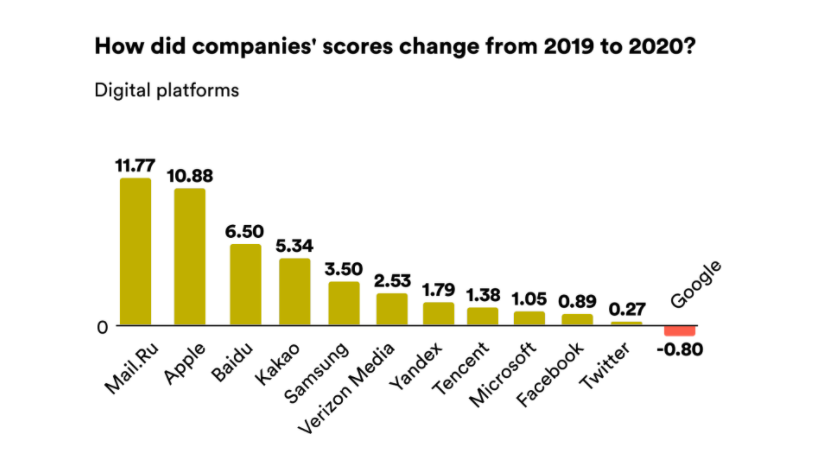
The above graph compares the amount by which digital platforms improved between 2019 and 2020, on indicators that remained unchanged between the two index cycles. Learn more.

In 2020, Baidu, which operates China’s leading search engine, improved significantly on indicators that held steady between our 2019 and 2020 indexes, as seen above.

In a surprising move in late 2020, Baidu published a human rights policy. The policy is limited in scope (the company pledges to protect human rights “within the bounds of national law”), but this was still an unusual step for a Chinese tech company.

What caused Baidu to do this? More broadly, what are the forces that push Chinese companies to change?

Spotlight on China’s tech giants

In her essay for the 2020 RDR Index, Rebecca offers an expert analysis of the market and political forces driving decision-making at Alibaba, Baidu, and Tencent. In the introduction, she writes:

China’s system of authoritarian internet control has inescapable consequences for Chinese companies in the RDR Index: Baidu and Tencent have always ranked at or near the bottom. In 2020, we evaluated e-commerce giant Alibaba for the first time, and it landed low in the overall ranking, right next to Baidu.
Yet at the same time, Chinese companies have taken meaningful steps over the past five years to protect consumer privacy and security from threats that are unrelated to Chinese government surveillance. They have also tried to be a bit more open with users about how content is moderated for reasons other than government censorship requirements. As a result, between 2018 and 2019 Tencent and Baidu were among the most improved companies in the RDR Index, albeit still hovering at or near the bottom of the ranking.
Their progress shows that Chinese companies can and do respond to pressure from foreign governments, investors, and even users. But the extent to which they can improve policies and practices affecting users’ human rights is severely handicapped by China’s legal and political system. The hard reality is that Chinese companies are powerless to protect users (whether they are in China or abroad) from digital rights violations by one of the most powerful—and unaccountable—governments in the world.

Read the essay → 


RDR media hits

MIT Technology Review: In a long read on how Facebook’s “relentless pursuit of growth” has increased polarization and the spread of misinformation, Karen Hao quoted RDR Editorial Director Ellery Biddle commenting on the company’s “Responsible AI” initiative:

“It seems like the ‘responsible AI’ framing is completely subjective to what a company decides it wants to care about. It’s like [saying], ‘We’ll make up the terms and then we’ll follow them.’ I don’t even understand what they mean when they talk about fairness. Do they think it’s fair to recommend that people join extremist groups, like the ones that stormed the Capitol? If everyone gets the recommendation, does that mean it was fair?” Read via Tech Review

Digital Privacy News: “Facebook is extremely opaque about how it develops and deploys algorithms,” RDR Research Director Amy Brouillette told Digital Privacy News, for a story on AI and privacy risks. “Facebook does not publicly commit to protect users’ expression and privacy rights as it trains and deploys algorithms…Nor does it conduct risk assessments about the impact of these systems on freedom of expression and privacy.” Read via Digital Privacy News

Protocol: Last week’s edition of the Protocol | China newsletter pointed to our research on the leading Chinese companies, noting that they published no information about how they handle government requests for user data. Read via Protocol

Bloomberg: A story on network shutdowns in Africa cited research by RDR Company Engagement Lead Jan Rydzak, which showed that curbing access to social media “tended to fuel rather than reduce violence.” The story continued: “internet shutdowns in Algeria and Sudan did nothing to quell protests—and may in fact have stoked outrage and accelerated their leaders’ downfalls.” Read via Bloomberg

Where to find us

CIPE Philippines | Putting Digital Rights on the Corporate Governance Agenda
March 23 at 9:00 PM EST | Register here
Rebecca will join the Center for International Private Enterprise, a core institute of the National Endowment for Democracy, to discuss technology’s role in democratic society in Southeast Asia.

The Policy Circle | Big Tech Tightrope: Balancing Free Speech, Privacy & Innovation
March 24 at 1:00 PM EST | Register here
Rebecca will join Steve DelBianco, president of NetChoice, and Jillian York, director of International Freedom of Expression at the Electronic Frontier Foundation to discuss the fundamentals of free speech on social media and public policy reforms for big tech companies.


Subscribe here to get The RADAR by email.