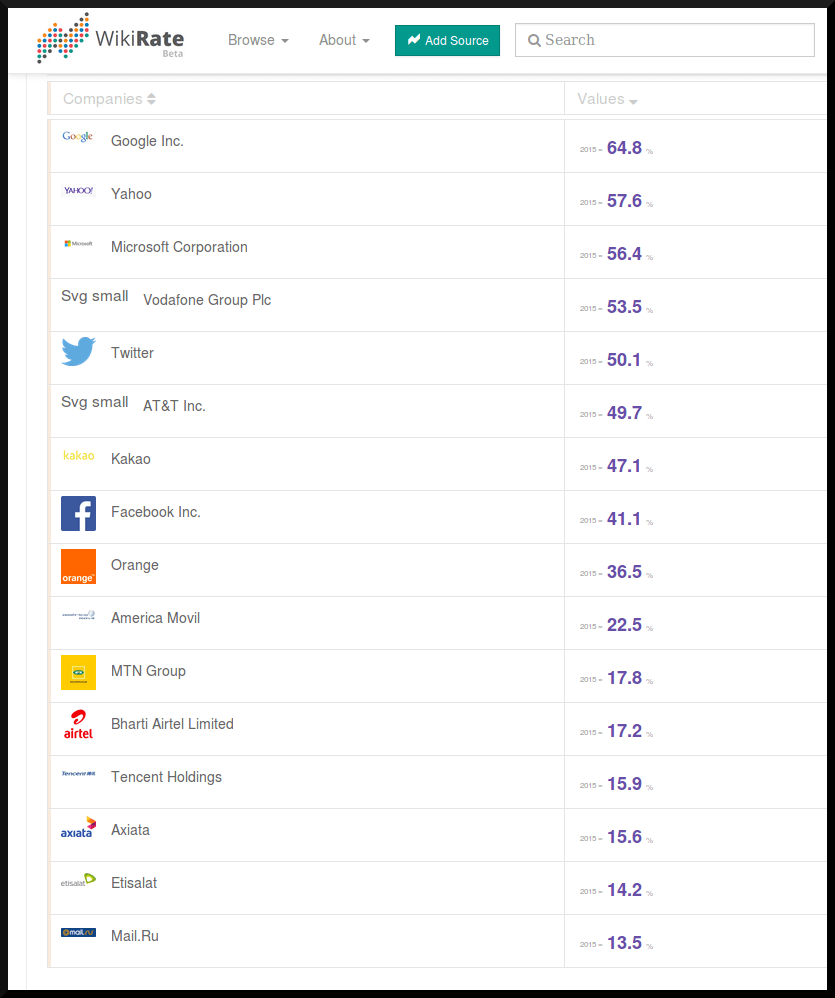
A majority of companies analyzed in Ranking Digital Rights’ 2015 Corporate Accountability Index have publicly responded to our findings, thanks to a campaign by digital rights group Access Now. As part of a public outreach effort launched this spring, Access Now sent letters to each of the 16 companies evaluated in the 2015 Index, asking them to respond to our findings and offering tailored recommendations for improving their policies affecting users’ freedom of expression and privacy rights.

Twelve of the 16 companies have responded to Access Now’s campaign, with many reporting they have taken steps to improve their commitments to freedom of expression and privacy standards in light of the Index results and Access Now’s recommendations.  

In response to Access Now’s letter to Kakao about the company’s Index results, which showed the company’s greater emphasis on privacy than freedom of expression, a senior executive of the South Korean Internet company wrote that it will “soon start to institutionalize our commitments to users’ freedom of expression at the same level of our commitments to privacy.” The company also said it was planning other improvements, including “clearer control options for collection of user information and more details of the company’s collection of user information.”

Microsoft reported plans to enhance its human rights grievance and remedy mechanisms, based on recommendations from Access Now. “We already have work underway to address some of Access Now’s primary recommendations, particularly around further enhancing our human rights grievance and remedy mechanisms,” the company wrote. Along with many of its peers, Microsoft’s performance on on remedy left much room for improvement.

AT&T also revealed it is taking steps to improve its human rights impact assessment practices. While our 2015 research found that AT&T carried out no human rights impact assessments on its U.S. operations, a company executive wrote that they are conducting human rights impact assessments on newly acquired Mexican wireless operations.

A number of companies, including Twitter, Yahoo and Facebook, reported new efforts to improve their transparency reporting. After the 2015 Index highlighted the lack of company disclosure about terms of service enforcement, Twitter’s February 2016 update of its transparency report included some data on terms of service enforcement. According to the company, it now includes “reports from government deputized reporters, a critical and growing area for transparency reporting. We included such reports not only in our transparency reports but in our disclosures to Lumen as well.”

Yahoo said the company is “actively studying, analyzing and considering the results and findings of RDR with respect to company transparency,” according to its response to Access Now’s letter. “We’re examining the issues at the core of the indicators and discussing the findings with our teams. We look forward to continuing this work and to continued dialogue with interested stakeholders.”

Facebook described a number of improvements it has made to its transparency report since the 2015 Index research was conducted, in addition to “enabling end-to-end encryption by default for all WhatsApp messages and voice conversations and extending Facebook over Tor support to our Android app.”

In its response to Access Now’s letter to Google, the company highlighted its commitment to freedom of expression and privacy, and reported it has “used the findings to guide internal discussions about how our practices and communications to the public can evolve.”

The successful campaign by Access Now highlights RDR’s multi-stakeholder approach and our strategy of engagement with companies, which we believe is key to furthering understanding among all stakeholders about how users’ rights are affected and what improvements can be made.

The Business & Human Rights Resource Center, which facilitated the dialogue between Access Now and the companies, provides a full overview of letters sent and company responses.

Since the launch of our 2015 Corporate Accountability Index in November, our hard-working team has undertaken a thorough review of the Index methodology, research process, and results. We have also expanded the methodology to cover more types of companies, products and services.

The result is a revised methodology for public comment and final stakeholder consultation. In order to facilitate feedback and enable easy comparison between the new draft version and the 2015 version, we are providing four separate PDF documents that can be downloaded via the following links:

Feedback on the revised methodology should be sent to feedback@rankingdigitalrights.org by August 5, 2016.

Readers of the above documents are also encouraged to review the results of the 2015 Index as well as the downloadable report and raw data, all available here.

As part of our effort to collect as much feedback as possible from a range of sources, members of our team will be reaching out to all companies ranked in 2015, companies that we are considering for inclusion in the next round, and other key stakeholders.

After feedback is absorbed and final revisions are made, data collection and analysis will begin in Fall 2016. We aim to publish the next iteration of the RDR Corporate Accountability Index in the first half of 2017, with more precise timing to be determined. Up to six companies will be added for the 2017 Index. The names of those companies will be made public when we publish the final revised methodology and launch the new research cycle.

We are excited to announce that data from the Ranking Digital Rights Corporate Accountability Index is now available in new ways and to new audiences through the Berkman Center’s Internet Monitor Dashboard.

The Internet Monitor Dashboard helps policymakers, researchers, advocates, and user communities understand trends in the Internet’s “health” and activity through data analysis and visualization. The Dashboard collects data on issues of Internet access & infrastructure, online content controls, and digital activity.

The inclusion of RDR’s Corporate Accountability Index, focusing on companies’ respect for freedom of expression and privacy rights, brings new insights about the private sector’s impact on the Internet to other data already available on the platform. One of the many great features of the Dashboard is that users can freely customize a personal board, adding widgets with other data types, changing sorting orders, creating data visualizations and embedding them on other sites.

The Dashboard also enables us to visualize our own data in new ways: by comparing services side-to-side. This allows consumers, researchers, and everyone else to compare a specific service, such as a social network or e-mail service, with competitors that we’ve ranked.

To help people to quickly grasp our Index findings, we have prepared a curated board that features a range of RDR data sets in one overview.

InternetMonitor-screenshot

The curated RDR board can be found here: https://dashboard.thenetmonitor.org/dashboards/6aNiYLZNBnDQ79Edw

In addition to the data as it is featured on our website and the Internet Monitor Dashboard, our raw index data is is freely available for everyone to access and use. We encourage others to use our data in other innovative ways. Stay tuned for more updates on this.

If you would like to learn more about how to use the Dashboard, have a look at this brief and very helpful tutorial: https://www.youtube.com/watch?v=PnjEXgJ1Ge0

Would you like to be part of a dynamic and innovative team working to improve ICT sector policies and practices affecting freedom of expression and privacy around the world? We have three job openings!!

Research Director or Manager (depending on seniority and experience): This person will oversee the planning and execution of research for the Ranking Digital Rights Corporate Accountability Index and related research activities. Click here for the full job description and to apply.

Project Manager: This person will lead the project’s grant-writing, budgeting, grants management and reporting work, while also supporting other project work including partner relationships and outreach efforts in cooperation with other staff. Click here for the full job description and to apply.

Program Associate or Research Analyst (depending on seniority and experience): This person will conduct research and manage the research database for the Ranking Digital Rights Corporate Accountability Index and related research activities. Click here for the full job description and to apply.

The RDR team welcomes the launch of Access Now’s latest advocacy campaign, targeting 10 of the companies evaluated in the 2015 Corporate Accountability Index. The campaign is a prime example of how advocacy groups can use the RDR Index findings for direct advocacy with companies in support of freedom of expression and privacy for technology users.

Access Now logoAccess Now, a long-time RDR partner, launches its outreach efforts today, in the form of a campaign of public letters addressed to companies that RDR ranked. The letters offer specific recommendations to help companies improve their practices affecting users’ rights and freedoms, addressing issues such as data protection, content restriction, digital security, and remedy. The recommendations are based directly on the 2015 Corporate Accountability Index findings.

As we noted upon release of the results, of the 16 companies ranked in the inaugural 2015 Corporate Accountability Index, the highest scoring company received an aggregate score of 65%, reflecting great room for improvement throughout these industries. However, nearly all companies demonstrated some positive practices and approaches. Access Now’s letters acknowledge the specific positives demonstrated by each company. At the same time, the letters urge companies to take seriously the Index findings, and remind them that demonstrating respect for users’ human rights, and transparently acknowledging commitments to do so, is good for business.

In every case, the Index revealed steps that each company can take in the direction of better respect for freedom of expression and privacy, not dependent on changes in their home countries’ laws. Access Now’s campaign acknowledges these steps, and urges companies to commit to making these improvements.

In addition, this campaign aims to catalyze conversations between companies and civil society organizations in countries where these companies are headquartered. Civil society organizations dedicated to promoting human rights and internet freedom will have these recommendations, and the Corporate Accountability Index findings generally, as references to support their own campaigns and engagement efforts.

Access Now’s campaign will include direct follow-up with each of the companies addressed in the letters, in order to discuss recommendations and encourage engagement with the issues addressed in the Index. The letters recommend as a first step that companies convene a meeting of their corporate officers in order to digest the 2015 Corporate Accountability Index findings, and develop a response. This request builds upon existing and continuing engagement efforts already initiated by RDR in the the months since the publication of the inaugural 2015 Index, during which ranked companies were invited to provide feedback on the ranking process as well as to discuss recommendations.