RDR is now an independent initiative. Our website is catching up.  Read our announcement →

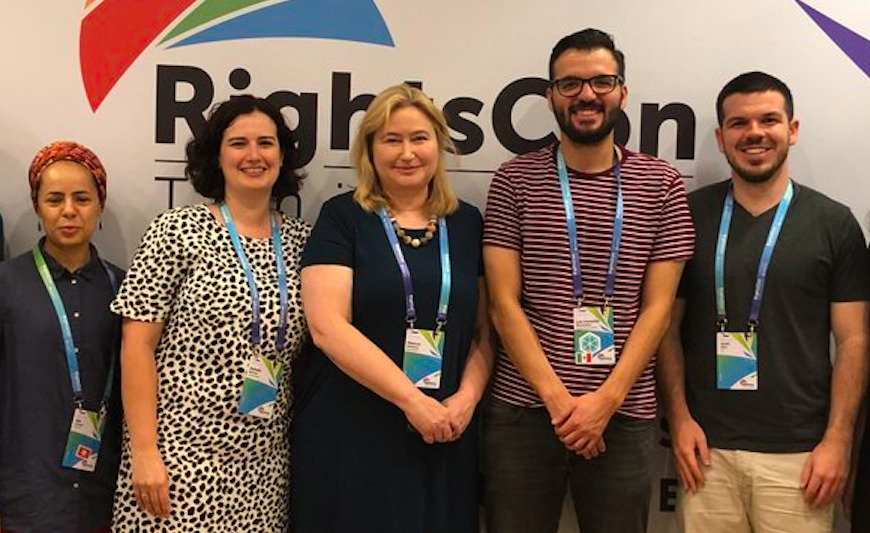
RDR staff and partners at RightsCon Tunis, 2019.

RDR staff and partners at RightsCon Tunis, 2019.

During the week of July 27, RDR researchers and policy staff will be joining colleagues from around the world for several sessions at RightsCon 2020, the online edition of AccessNow‘s annual conference focused on technology, human rights, and business.

While we will miss chatting with you in the halls and on coffee breaks, we hope to see you at these and other sessions, and to connect on Twitter!

Monday, July 27

How do we know we can trust you? Weighing the strength of platforms’ commitments to provide content moderation appeals
Time: 11:15am-12:15pm EDT · Session number: 8260
Track: Content governance, disinformation, and online hate
Speakers:


(Un)free speech: When algorithms decide
Time: 12:30-1:30pm EDT · Session number: 8995
A strategy session hosted by the OSCE Representative on Freedom of the Media
Speakers:

Tuesday, July 28

Real corporate accountability for surveillance capitalism: Setting the civil society agenda for the 2020s
Time: 11:30am-12:30pm EDT · Session number: 8606
Track: Alternative models for business and labor
Speakers:

Thursday, July 30

Is the tech greener on the other side? Benchmarking tech companies’ environmental sustainability
Time: 9:00-10:00am EDT · Session number: 8522
Track: Alternative models for business and labor
A strategy session hosted by RDR’s Nathalie Maréchal, Jan Rydzak and Zak Rogoff

Friday, July 31

Digital curfew in a conflict zone and its impact on gender rights, education and economy
Time: 5:45-6:45am EDT · Session number: 9091
Track: Network connectivity and internet shutdowns
Speakers:

Protest against police violence in Minneapolis, Minnesota. Photo by Lorie Shaull via Flickr (CC BY-SA 2.0)

This is the RADAR, Ranking Digital Rights’ newsletter. This edition was sent on July 16, 2020. Subscribe here to get The Radar by email.

Since our last newsletter, we’ve published our methodology for the 2020 RDR Index , which will evaluate two new companies — Amazon and Alibaba— and include new indicators on targeted advertising and algorithmic systems. Amid a global pandemic and mass protests against systemic racism, this might not sound like big news. But as issues like free speech, police surveillance, and contact-tracing technology dominate our daily conversations, we’re seeing how tech companies’ algorithms and ad-targeting systems are having real-life implications at this watershed moment in history.

Several companies in the RDR Index have made headlines to this effect in recent weeks. After years of pressure from groups like the Algorithmic Justice League, Microsoft vowed to stop selling facial recognition software until the U.S. has “a national law in place, grounded in human rights” to govern it. Amazon announced a one-year moratorium on police use of its Rekognition software, leaving plenty of room for improvement.

More than 500 companies — including Coca-Cola, Unilever, Target, and Verizon— have pulled their ads from Facebook in response to #StopHateforProfit, a coalition-led campaign calling on the company to stop the proliferation of white supremacist content, incitement to violence, and messages of voter suppression across its platform, and to build stronger mechanisms for ensuring accountability and transparency.

But it’s not just hateful or misleading content that’s the problem — it’s the business model. The underlying logic of #StopHateforProfit — that Facebook will continue to allow problematic content for as long as it is profitable — goes hand-in-hand with the key argument in It’s the Business Model, our spring 2020 series. In these two reports, we showed how targeted advertising and algorithms drive the amplification of misleading and hateful content (and skyrocketing profits) at Big Tech firms, often at the expense of democracy and human rights.

RDR Senior Policy Analyst Nathalie Maréchal spoke about our “It’s the Business Model” report series at a virtual panel discussion with the Open Technology Institute, Amnesty International, and the National Fair Housing Alliance. Watch the video here.

We are also worried about free speech in the Trump era. In the face of heavy public criticism over his handling of the pandemic and the protest movement, the U.S. president is increasingly turning to authoritarian-style threats and tactics. In an op-ed for CNN, RDR Director Rebecca MacKinnon compared Trump’s perennial attacks on legitimate media outlets and social media companies — including his recent Executive Order targeting Twitter — to those of China. “Authoritarian leaders like China’s Xi Jinping bend the law to serve their purposes and reinforce their power,” she wrote. “Trump is trying to do the same.”

And then there’s the shakeup at the US Agency for Global Media. In addition to firing several people in lead editorial roles, the new regime has posed an existential threat to the Open Technology Fund (OTF), a leading supporter of developers working on open-source, privacy-protecting technologies like Signal, the secure messaging app used by protesters from Hong Kong to Minneapolis. We don’t yet evaluate these tools, but we applaud the standards of transparency and openness that OTF has built into their processes.

As MacKinnon put it in a piece for Slate, “Their open research, computer code, and security training techniques are being used around the world by all sorts of people. They are helping everybody everywhere who dares to speak truth to power…”

More on the 2020 RDR Index

The forthcoming 2020 RDR Index (coming out in February 2021) will include new indicators that set global accountability and transparency standards for how companies can demonstrate respect for human rights online as they develop and deploy targeted advertising and algorithmic systems.

We also expanded the RDR Index to include Amazon and Alibaba, two of the world’s largest e-commerce companies. This means we’ll incorporate two new services — e-commerce platforms and “personal digital assistant ecosystems” — into the 2020 RDR Index methodology. Read all about our methodology revision process, or see the full roster of indicators for 2020.

Pings: RDR in the news

Hong Kongers recently went to the polls but faced technical challenges when the iOS PopVote app — a key tool for the citizen-led voting process — malfunctioned and Apple failed to respond to maintenance requests. While Google, Twitter, and Facebook have halted data-processing requests from authorities in light of the new national security law, Apple has yet to respond, adding to activists’ frustrations with the company. RDR Director Rebecca Mackinnon shared her perspective with Quartz: “It’s a situation in which the companies have to decide which bad options they want to go for. It’s hard to see how they can remain in Hong Kong and not be complicit.”

A new test feature on Twitter attempts to slow the flow of disinformation by suggesting users read an article before retweeting a link to it. Consumer Reports interviewed RDR Senior Policy Analyst Nathalie Maréchal about the development and rollout of the test: “I’m glad to see that Twitter is thinking about how to address some of the endemic problems on the platform,” she said. “But since they are, in effect, running live experiments on their users, it would be good to see more transparency about the process.”

Speaking with Slate about the #StopHateforProfit campaign, RDR Director Rebecca MacKinnon pointed out that ad revenue losses could also put investors at risk: “If I was a mutual fund with major holdings with Facebook, I would be [saying to them] ‘You have a serious problem here, with parts of the market not wanting to be associated with what you seem to represent now.’”

Internet shutdowns are defining India’s national psyche, according to Thought Jungle’s Toya Singh. She cited scholarly research by RDR Company Engagement Lead Jan Rydzak that examines the connection between network shutdowns and collective action responses in India.

Our research on human rights risks associated with algorithms and AI was cited multiple times in “Spotlight on Artificial Intelligence and Freedom of Expression,” a new report from the OSCE’s Representative on Freedom of the Media.

Ranking Digital Rights’ 2018 assessment of Telefónica was included in a GSMA deep dive report presenting human rights guidance for the mobile industry. Among companies ranked by RDR in 2018, Telefónica disclosed the most about its policies impacting freedom of speech and government requests to restrict content and services.
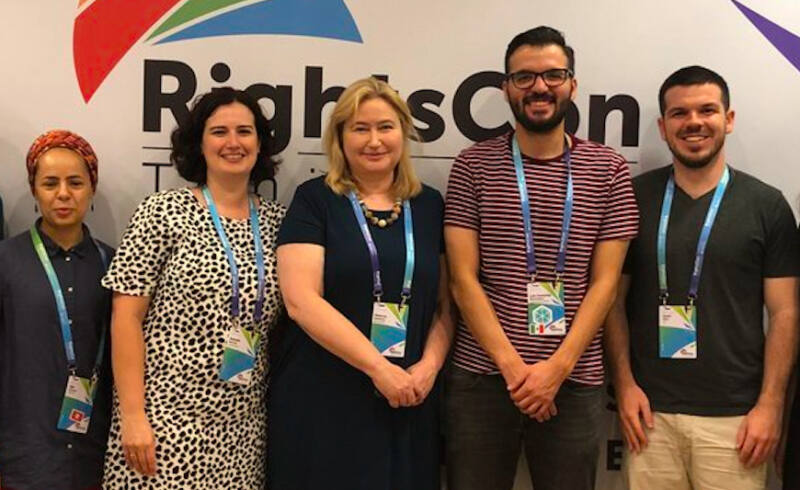
RDR staff and partners at RightsCon Tunis, 2019.

RDR staff and partners at RightsCon Tunis, 2019.

Where in the world is RDR?

RightsCon Online 2020: Our team will participate in multiple sessions at RightsCon Online, hosted by Access Now. These will include:

Real Corporate Accountability For Surveillance Capitalism: Setting The Civil Society Agenda For The 2020s
July 28 at 11:30am EDT
Speakers: RDR Senior Policy Analyst Nathalie Maréchal, Shoshana Zuboff (Harvard Business School), Joe Westby (Amnesty International), and Chris Gilliard (digital privacy scholar)

Digital Curfew in a Conflict Zone and its Impact on Gender Rights
July 31 at 5:45am EDT
Speakers: RDR’s Jan Rydzak, Tanzeel Khan (digital rights activist), Radhika Jhalani (Software Freedom Law Centre India), and Kris Ruijgrok (Open Technology Fund Fellow)

Is The Tech Greener On The Other Side? Benchmarking Tech Companies’ Environmental Sustainability
July 30 at 9:00am EDT
Speakers: RDR’s Nathalie Maréchal, Jan Rydzak and Zak Rogoff

How do we know we can trust you? Weighing the strength of platforms’ commitments to provide content moderation appeals
July 27 at 11:15am EDT
Speakers: RDR’s Zak Rogoff, Tomiwa Ilori (University of Pretoria), Spandana Singh (Open Technology Institute), Jeremy Malcolm (Prostasia Foundation), Kim Malfacini (Facebook)

(Un)free Speech: When Algorithms Decide
July 27 at 12:30pm EDT
Speakers: RDR’s Nathalie Maréchal, Camille François (Graphika), Natali Helberger (University of Amsterdam), Julia Haas (OSCE Office of the Representative on Freedom of the Media)

Public Knowledge: How Do We Move Beyond Consent Models in Privacy Legislation?
July 29, 1:30pm EDT
RDR’s Nathalie Maréchal will join Senator Sherrod Brown, Joseph Turow (University of Pennsylvania), Stephanie Nguyen (Consumer Reports), and Yosef Getachew (Common Cause) to discuss viable frameworks for federal privacy legislation.

The scan: What we’re reading

America the Unexceptional: In an essay for Foreign Policy, UN Special Rapporteur on Freedom of Expression David Kaye analyzes the U.S. government’s history of focusing on human rights abroad, while turning a blind eye to rights violations at home, particularly against Black Americans. Pointing to segregationists who fought to keep the U.S. from engaging in the international human rights system, Kaye writes: “racism and white supremacy drove the American refusal to enforce human rights at home, and that legacy of hypocrisy shapes human rights policy today.”

What does it mean to see privacy as a civil rights struggle? Writing for Salon, UC San Diego Chief Information Security Officer Michael Corn argues that “we’re losing the war against surveillance capitalism because we let Big Tech frame the debate.” For Corn, in a digital world, privacy is the spine of the body politic, forming a barrier between civil society and racial, political, and religious profiling, and shaping culture at large.

In The Data Delusion, Luminate Managing Director Martin Tisné looks ahead to legal implications and policy decisions invoked by machine learning. He writes: “Solutions lie in hard accountability, strong regulatory oversight of data-driven decision making, and the ability to audit and inspect the decisions and impacts of algorithms on society.”

Put us on your radar! Subscribe to The RADAR to receive our newsletter by email.

Original art by Paweł Kuczyński.

From friends’ status updates, to messages from political candidates, to regular old ads, what we see on the internet today is rarely left to chance. Online and on our digital devices, technology companies track our every move, collecting troves of information about us that can be used to influence what we buy, how we vote, and much more. The technologies underlying these processes — targeted advertising and algorithmic systems — pose critical threats to users’ rights to privacy, free expression, and access to information.

Today, we are excited to release our newly updated methodology, which aims to address the increasingly complex human rights threats posed by algorithms and ad targeting technologies. We also have expanded our index to evaluate new types of services offered by Amazon and Alibaba.

Developed over more than a year of research, pilot testing, and stakeholder consultations, our new indicators set global accountability and transparency standards grounded in the Universal Declaration of Human Rights. As always, our indicators demonstrate how tech companies can respect and protect human rights online as they develop and deploy new technologies.

In the months ahead, we will be conducting research for the 2020 RDR Index, which will rank 26 companies using our updated indicators. More than 30 researchers around the world will participate in this rigorous process of data collection, verification, cross checking, and review. We plan to publish our results in February 2021.

Learn more:

Stay tuned for more updates on our work!

Original art by Paweł Kuczyński

As the country struggles to respond to COVID-19 and the 2020 elections approach, misinformation on social media abounds, posing a public health threat and a threat to our democracy. In RDR’s new report, “Getting to the Source of Infodemics: It’s the Business Model,” RDR Senior Policy Analyst Nathalie Maréchal, Director Rebecca MacKinnon, and I examine how we got here and what companies and the U.S. Congress can do to curb the power of targeted advertising to spread misinformation.

Targeted advertising relies on the processing of vast amounts of user data, which is then used to profile and target users without their clear knowledge or consent. While some other policy proposals focus on holding companies liable for their users’ online speech, our report calls for getting to the root of the problem: We describe concrete steps that  Congress can take to  hold social media companies accountable for their targeted advertising business model and the algorithmic systems that drive it.

This is the second in our two-part series on targeted advertising and algorithmic systems. The first report, “It’s Not Just the Content, It’s the Business Model: Democracy’s Online Speech Challenge,” written by Maréchal and journalist and digital rights advocate Ellery Roberts Biddle, explained how algorithms determine the spread and placement of user-generated content and paid advertising and why forcing companies to take down more content, more quickly is ineffective and would be disastrous for free speech.

In this second part of our series, we argue that international human rights standards provide a framework for holding social media platforms accountable for their social impact that complements existing U.S. law and can help lawmakers determine how best to regulate these companies without curtailing users’ rights.

Drawing on our five years of research for the Ranking Digital Rights (RDR) Corporate Accountability Index, we point to concrete ways that the three social media giants have failed to respect users’ human rights as they deploy targeted advertising business models and algorithmic systems. We describe how the absence of data protection rules enables the unrestricted use of algorithms to make assumptions about users that determine what content they see and what advertising is targeted to them. It is precisely this targeting that can result in discriminatory practices as well as the amplification of misinformation and harmful speech. We then present concrete areas where Congress needs to act to mitigate the harms of misinformation and other dangerous speech without compromising free expression and privacy: transparency and accountability for online advertising, starting with political ads; federal privacy law; and corporate governance reform.

First, we urge U.S. policymakers to enact federal privacy law that protects people from the harmful impact of targeted advertising. Such a law should ensure effective enforcement by designating an existing federal agency, or create a new agency, to enforce privacy and transparency requirements applicable to digital platforms. The law must include strong data-minimization and purpose limitation provisions. This means, among other things, that users should not be able to opt-in to discriminatory advertising or to the collection of data that would enable it. Companies must also give users very clear control over collection and sharing of their information. Congress should restrict how companies are able to target users, including prohibiting the use of third-party data to target specific individuals, as well as discriminatory advertising that violates users’ civil rights.

Second, Congress should require that platforms maintain a public ad database to ensure compliance with all privacy and civil rights laws when engaging in ad targeting. Legislators must break the current deadlock and pass the Honest Ads Act, expand the public ad database to include all advertisements, and allow regulators and researchers to audit it.

Finally, Congress should require relevant disclosure and due diligence around the social and human rights impact of targeted advertising and algorithmic systems. This means mandating disclosure of targeted advertising revenue, along with disclosure of environmental, social, and governance (ESG) information, including information relevant to the social impact of targeted advertising and algorithmic systems.

Political deadlock in Washington, D.C., has closed the window for lawmakers to act in time for the November 2020 elections, but this issue must be a bipartisan priority in future legislative sessions. In the meantime the companies should take immediate, voluntary steps to anticipate and mitigate the negative impact of targeted advertising and related algorithmic systems on the upcoming elections: We call on Facebook, Google, and Twitter to curtail political ad targeting between now and the November elections in order to dramatically reduce the flow and impact of election-related disinformation and misinformation on social media.

Please read the report, join the conversation on Twitter using #itsthebusinessmodel, and email us at itsthebusinessmodel@rankingdigitalrights.org with your feedback and to request a webinar for your organization.

We would like to thank Craig Newmark Philanthropies for making this report possible.

Image from Shutterstock: Mobile
Shutterstock

In early 2019, RDR began the process of revising and expanding the methodology for the 2020 RDR Corporate Accountability Index to address the human rights harms associated with companies’ use of targeted advertising and algorithmic systems, and to widen our scope to include new types of services offered by Amazon and Alibaba. Since then, we have published a set of draft indicators that address companies’ targeted advertising policies and practices and their development and use of algorithmic systems, and we released the results of a pilot study of these indicators.

Today, we are excited to share a draft of the full 2020 RDR Index methodology and open it for public feedback. In order to facilitate this input, we have broken down the consultation documents into three PDFs that can be downloaded from the following links:

Feedback on the draft methodology should be sent to methodology@rankingdigitalrights.org by May 15, 2020.

Our team will also conduct focused outreach to companies, human rights experts, civil society organizations, and other key stakeholders in the coming weeks. These consultations will help inform our decisions regarding the final 2020 RDR Index methodology.

We plan to publish the final 2020 RDR Index methodology, including the list of companies and services that will be included in the ranking, in early June.

We welcome input from all stakeholders!