RDR is now an independent initiative. Our website is catching up.  Read our announcement →

For the second year in a row, the Ranking Digital Rights team joined hundreds of advocates, technologists, government officials, and company representatives at RightsCon, a key annual gathering focused on Internet and human rights organized by our good friends at Access. This year’s conference was held in Manila, where we were thrilled to meet activists, researchers, and company representatives from all over Asia.

We shared our pilot study results and collected valuable feedback on how the project can help others who fight to defend digital rights. In a public session focused on setting clear standards for companies, panelists Donny BU of ICT Watch Indonesia, Nighat Dad of Pakistan’s Digital Rights Foundation, and Charles Mok, a Hong Kong legislator, joined Rebecca MacKinnon to discuss RDR’s goals and work.
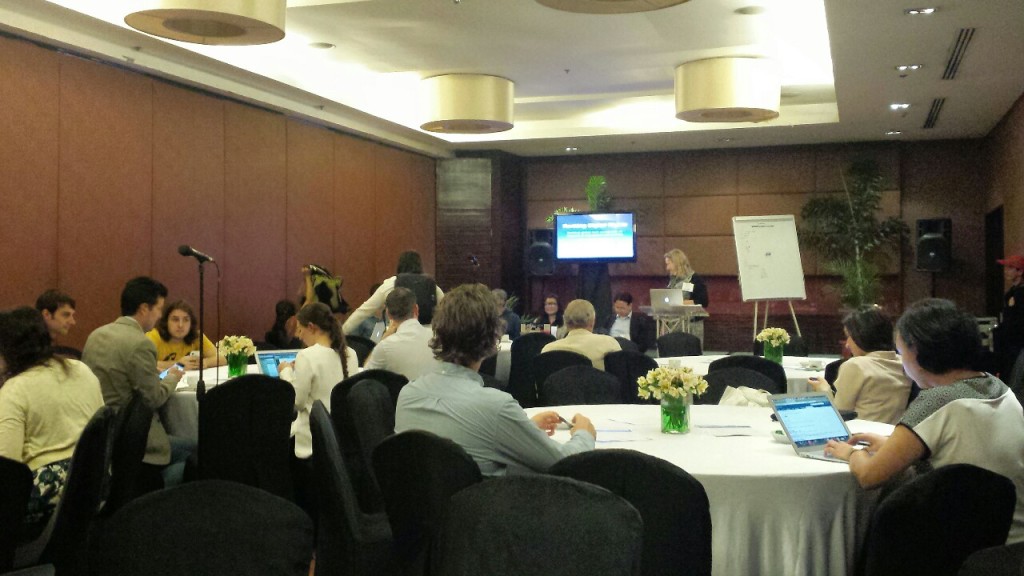
RDR's public session at RightsCon Manila. Photo: RightsCon

RDR’s public session at RightsCon Manila. Photo: RightsCon

The companies that RDR evaluates are based around the world and operate in varied cultural environments and legal contexts. Even so, Donny BU asserted that it is fair to hold companies to standards that are grounded in international human rights principles, as RDR’s methodology does. Nighat Dad highlighted the need for more transparency on company practices, particularly when governments compel companies to act in a certain way. Citizens deserve to know if government requirements make a country’s business environment uncompetitive, Charles Mok added.

The Internet and human rights community faces myriad challenges in advocating for freedom of expression, privacy, and other online rights. RDR team members lent their expertise to several related discussions at RightsCon. We participated in the final drafting and launch of the Manila Principles on Intermediary Liability. RDR research fellow Tim Libert described his work on evaluating how mobile devices affect human rights, which relates directly to RDR’s phase two efforts to integrate software, device, and networking equipment manufacturers into the ranking. Allon Bar presented findings from the UNESCO report, “Fostering Freedom Online: The Role of Internet Intermediaries.” Rebecca MacKinnon spoke on panels about the Global Network Initiative, the need for remedy when people experience human rights violations online, the need for frameworks to address cross-border requests to remove online content, and the meaning of democracy in a networked era.

We also met with individuals from NGOs based around the world to discuss the project’s goals and how its ranking results can help other organizations in their research and advocacy work. Our first public ranking of Internet and telecommunications companies will be released in November. Prior to launch, we plan to work with a range of NGOs and researchers so that they will be prepared to use the information we publish to advance their own advocacy and research goals.

The ranking will examine publicly available information and companies’ own disclosures about their policy commitments and practices affecting users’ freedom of expression and privacy. The results and accompanying analysis will describe how companies can improve. The ranking will also highlight ways in which government regulation and laws prevent companies from respecting users’ rights. These details can help NGOs start conversations with companies about how to better respect users’ rights. In cases where government is the source of the problem, our data and analysis can provide facts that NGOs and companies can use to jointly pressure governments.

Several NGOs from across Asia and Latin America expressed interest in using RDR’s methodology as a template to examine or benchmark companies operating in their countries or regions. They told us it would be helpful to have the ranking results available in multiple languages and to receive training or guidance on how to apply the methodology to their local environment. RDR does not currently have resources for translation and training, but we welcome institutional partners who might be able to help us make the data and analysis accessible to more people in more languages and national contexts.

We left RightsCon excited about people’s enthusiasm for RDR, especially their desire to use the methodology we’ve developed and the data we will publish later this year. The global universe of ICT companies is much larger than what RDR (or any single organization) can currently evaluate, but if more organizations apply the methodology to their regions, develop other research projects to examine companies’ local practices and impact, and use the results to inform advocacy, we as a community can develop a more granular picture of where free expression and privacy stand in the ICT sector and where they might be headed. This will strengthen everyone’s efforts to fight for users’ rights.

From October 2014-January 2015 the RDR team and our partners at Sustainalytics conducted a pilot study to test our Phase 1 methodology on 12 Internet and telecommunications companies. We have now published the results of that study here.

anon_overall_score

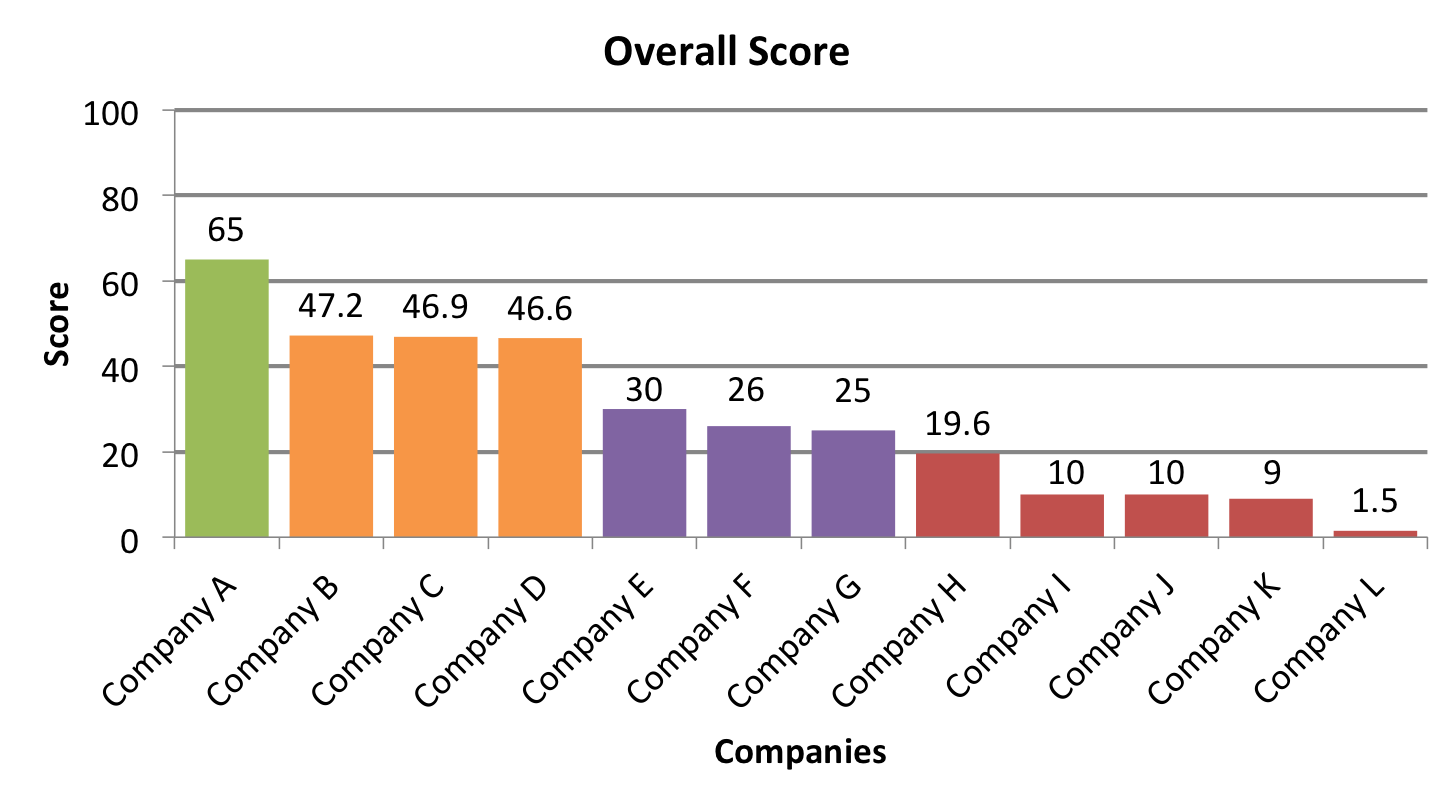
Company names are redacted because the methodology was experimental. Based on what we learned, we will spend the next several weeks revising and refining the indicators and research process. We will then apply the improved methodology to a public ranking that we expect to release in November.

As you can see from the bar chart of companies’ overall scores taken from page 9 of the report (click on the image to enlarge), the best-performing company scored only 65 out of a possible 100. No other company scored above 50. The lowest-scoring company received partial points on only two indicators. (Click here to read all of the indicator questions.) To be fair, there are plenty of regulatory and government-related factors at play – and those factors will be discussed as part of the analysis accompanying company scores when the public ranking comes out. Nonetheless, we believe that all companies have substantial room for improvement, regardless of the legal and political environments in which they operate. We look forward to setting clear benchmarks for companies’ future progress when we launch the inaugural public ranking in November.

Last month we shared a draft of the pilot report with several dozen investors, human rights advocates, technologists, academics, and experts in business and human rights.  We then sought their feedback either in person or via teleconference in five meetings held across North America and Europe. Some key comments are summarized near the end of the report. All of the very thoughtful suggestions we received will help us to make difficult decisions about how to revise, refine, and streamline the methodology and research process. Importantly, many companies chose to engage with our research team during the methodology development process as well as during the pilot study itself. Company feedback has been invaluable as we consider how to revise our indicators.

Further public feedback and comment on the pilot report are very welcome as we begin the revision process. Comments received before the end of March will be especially useful given that we hope to complete our revision process in April.

The RDR team is heading to Manila for next week’s RightsCon, an annual conference “bringing together civil society, engineers, activists, lawyers, companies, and governments on the subject of the internet and human rights.” The program is full of great sessions.

If you are coming be sure to join our special session, “Ranking Digital Rights: Setting Clear Standards for Companies” on Day 2, Wednesday March 25 from 9:15-10:30am in room Ruby A. The purpose is to brainstorm with the community about how the data we produce can be used by activists, researchers, and companies themselves.

We will also hold private meetings with activists and companies to answer questions and brainstorm further about how we can make sure that the ranking will be useful to them and have the greatest impact possible.

In addition to our public session and side meetings we will also be active in a number of other great panels. Please come join us! Here is a full list:

Day 1, 12:45-1:45pm“The GNI: Responsible Company Decision-Making in the ICT Sector” (panelists include: Rebecca MacKinnon)

Day 1, 2:00-3:15pm“Fix-it Felix: Best Practices for Remedying Violations Against Users” (panelists include: Rebecca MacKinnon)

Day 1, 5:00-6:15pm – Lightning talk by Tim Libert: “Smartphones and Human Rights: Developing Evaluative Criteria for Complex Systems”

Day 2, 9:15-10:30am – “Ranking Digital Rights: Setting Clear Standards for Companies” with the RDR team and speakers Charles Mok (Legislative Council, Hong Kong), Nighat Dad (Digital Rights Foundation, Pakistan) and Donny BU (ICT Watch, Indonesia)

Day 2, 10:45am-12:00pm“Establishing Due Process & Transparency for Cross-Border Requests: Challenges in SEA” (panelists include: Rebecca MacKinnon)

Day 2, 12:15-1:15pm“Fostering Freedom Online: The Role of Internet Intermediaries” (panelists include: Allon Bar)

Day 2, 3:00-4:15“Democracy 3.0” (panelists include: Rebecca MacKinnon)

Research and analysis has now been completed on the Phase 1 Pilot Study conducted in partnership with Sustainalytics, a leading independent research firm with extensive experience assessing the environmental, social, and governance (ESG) performance of global companies.

The purpose of the study was to test the latest iteration of our Phase 1 methodology on 12 companies. Based on what we’ve learned from the pilot, we will further revise the methodology and research process before implementing the full Phase 1 ranking for public launch in late 2015.  To that end, we have written the first draft of a pilot report. Over the next several weeks we will seek feedback on the draft from stakeholders and experts. After further revision we plan to publish it later in March.

We are also pleased to announce the publication of several new documents that help to explain the research and consultation process that we undertook to develop the methodology:

Links to those documents and other resources related to the methodology development, plus links to all versions of the methodology, can be found on this page.

Netgain” is a consortium of philanthropic foundations (including several RDR funders) hoping to support good work that will make the Internet open, free, and compatible with social justice. They describe their purpose as follows:

The Internet has transformed how we connect and engage with the world around us, creating challenges and opportunities in every area of contemporary life. It can be used to foster enlightenment and learning, and to promote justice. It can also be used to exert control, stifle legitimate discourse, and concentrate power in the hands of a few. The web’s ubiquitous nature and power demands that we work together to ensure that it serves the common good.

The Knight, MacArthur, Open Society, Mozilla, and Ford Foundations have come together with leaders from government, philanthropy, business, and the tech world to launch an ambitious new partnership to spark the next generation of innovation for social change and progress.

They reached out to some of their grantees and thought leaders to “submit your ideas…and help us focus on the most significant challenges at the intersection of the Internet and philanthropy.” The following submission reflects the ecosystem of research and advocacy within which RDR works. By building a mechanism to promote transparency and accountability in the private sector, we hope to address a very specific piece of the broader challenge described below.

The forces of repression have evolved to survive and thrive in a networked world. Philanthropy’s response must similarly evolve to meet the threat. Today, Internet-empowered civil society is under fierce attack on all continents. Those who control the means of physical violence have grown skillful at counter-manipulation of technology, law, and media. Democracies are not immune. In pursuit of security and self-interest, citizens and consumers unwittingly consent to their own repression. Politicians seek quick fixes to win elections. Companies rushing to meet market demand can be blind to collateral damage on legal and technical architectures that keep information systems – and by extension social and political systems – open and accountable. Let’s map out where abuses of power are occurring within the world’s information ecosystems. Pinpoint where accountability mechanisms fail and where they are completely absent. Then put together a strategy to hold power accountable in the Internet age.

Click here to see how others are responding to the challenge.