RDR is now an independent initiative. Our website is catching up.  Read our announcement →

Today, Ranking Digital Rights is renewing its mission as an independent initiative. Thirteen years into our efforts to hold the world’s technology giants accountable, we are doubling down on solidarity and standing up to confront a new wave of tech power,

We’re proud to team up with Superbloom Design, whose determination to change who technology serves resonates deeply with our vision and values. Superbloom’s fiscal sponsorship will safeguard RDR’s agency and autonomy as an initiative. It will also help form new bonds of partnership and support distributed oversight of technology alongside the communities who bear the brunt of tech oligarchs’ choices.

Why This? Why Now?

Tech power has shifted dramatically over the past decade, but its overall directions remain clear: scale, growth, and consolidation of corporate control.

The recipe for “success” among dominant players is also clear. To extract value from users, tech giants can maximize attention retention, screen time, and behavioral nudging, monetize reams of data, and rush to deploy products before accounting for harm. To extract value from markets, they can lobby for deregulation, buy up challengers, capture struggling industries, exploit labor across their value chains, and solidify power dependencies. The spread of new AI systems has only entrenched these mechanics and widened the accountability vacuum.

We can’t fill this vacuum with good intentions alone. But the initiatives that fight to protect human rights and hold tech accountable are struggling to stay alive at the time they’re needed the most. Grassroots movements worldwide have been crippled or dissolved en masse since early 2025, battered by wanton funding cuts and anti-NGO laws. Some tech giants explicitly planned to capitalize on the chaos by launching highly invasive products at a time when civil society groups are “distracted” by existential threats.

For tech accountability organizations, the pressure comes in many flavors: pressure to lower our standards, to accept corporate funding, to automate cognitive and creative labor, to put survival before community, or to surrender entirely. Too often, these dynamics are invisible until it’s too late.

We believe there is a different path. Resisting these pressures is possible. We’re embracing a gravitational turn toward shared resilience, self-determination, and mutual support amid countless centralizing forces. Our hope is to embody and normalize an operating model that puts those values first.

Deep Roots

RDR emerged nearly 15 years ago to advance transparency and accountability among platform and telecom giants. Our roots are in investigative journalism, independent research, and advocacy. Defending them is more vital than ever in an era of distorted truth.

Our founder, Rebecca MacKinnon, launched RDR with a promise to anchor its work in international human rights standards, centering privacy as well as freedom of expression and information. We’ve held true to that promise over seven editions of the RDR Index, offering a refuge of stability and rigor in a universe of shapeshifting ethical frameworks.

More than a decade later, the Index has chronicled dramatic realignments among tech juggernauts. We’ve dissected historic implosions of platform transparency and sustained surges of disclosure among telecom giants in the Global Majority. We were among the first to center the need to address surveillance-based business models to advance true tech accountability. We won the respect and vigorous engagement of companies and industry groups. And we rallied investors to the cause with steadfast allies like the Investor Alliance for Human Rights.

But every organization has a duty to confront its operating dogmas. Their structural and strategic limitations become more salient in times of crisis, which are the ultimate test of our values. We need to ask ourselves a few questions: Where does power lie? Who gains from our work? Whom are we doing this for?

New Pathways

We must respond to the runaway consolidation of corporate power with decentralized action and shared resilience. What does this mean in practice for an initiative like RDR?

First, it means we will investigate new gatekeepers of tech power. Our monitoring will expand to platform heavyweights beyond those we already cover. Power brokers abound in other corners of the tech industry, from surveillance and streaming companies to fintech and gaming giants. Many of them receive far less scrutiny despite acting as modern-day intermediaries of human rights.

We will put these new tech gatekeepers under the microscope through collaborative flash investigations that will transcend our traditional focus on privacy and freedom of expression. A new program will break down transparency, power, and partnerships among purveyors of generative AI, building on years of algorithmic standard setting. We will welcome dialogue with companies under the mutual understanding that our role is to advance accountability, not facilitate transparency washing.

Second, it means we will engage challengers to Big Tech incumbents. The 2025 RDR Index exposed years’ worth of policy rollbacks and paralyzed progress among US tech giants. The broader trend makes one thing clear: on some fronts, Big Tech won’t narrow the most critical gaps any time soon. But communities, countries, and continents are catching on to the perils of making themselves dependent on centralized tech power. Smaller platforms, regional initiatives, and Indigenous data governance projects are all explicitly exploring paths away from the default options and toward greater community control. Every alternative platform with the potential to safeguard the rights that Big Tech could not is a pocket of hope that RDR will embolden, without compromising our integrity or overcatering to corporate interests. 

Third and most importantly, it means we will champion community power. We have a duty to lift others up like we have been lifted up before. We will design all of our new projects as partnerships, with proper compensation for our collaborators and priority for small initiatives enduring resource constraints. Our flagship research is already co-led by experts at the International Corporate Accountability Roundtable (ICAR) and supported by a global community of digital rights researchers. Its many homes strengthen its resilience.

Years ago, we pledged to help localize tech accountability research and support those advancing it. Independent researchers and activists in more than 40 countries have since adapted the RDR Index to their environments, reimagined it to center the rights of communities facing severe human rights risks, and used our tools to customize and recalibrate due diligence processes. We are determined to help take such efforts further. Decentralization and mutual aid aren’t just strategies to fill blind spots; they are antidotes for systemic ills and core to shared resilience.  

Recoding Governance

The corporate tech landscape is rife with cautionary tales about the consequences of infinite growth and chronic consolidation. We are revitalizing RDR not to expand, but to diversify.  Scale and capital are not our key markers of success. All too often, they serve as flawed proxies for growth or impact and generate risk in turbulent times.

Trust, integrity, and strong bonds are far less quantifiable, and to us, far more important. RDR’s new Community Advisors will support us in developing our vision of cooperative governance, internal accountability, and operational principles based on strong values. The inaugural cohort includes RDR’s Founding Director Rebecca MacKinnon (Berkman Klein Center) as well as long-time collaborators Anita Dorett (Investor Alliance for Human Rights), Roya Pakzad (Taraaz), and Shu Dar Yao (Lucid Capitalism).

Together we will shape a community council representative of the range of people who have imbued RDR’s work with new identities outside our walls. To encourage human rights collectives who are quietly rebuilding their own efforts, we will report on our inner workings and the lessons we learn from designing democratic governance mechanisms.

Rewilding Tech Accountability

Purpose-driven revivals are a privilege at a time of widespread systemic breakdown and seemingly incurable power imbalances. A handful of staunch believers in RDR’s cause made ours possible. We are grateful to the World Benchmarking Alliance, which stewarded RDR over the last two years, for supporting our path toward autonomy. We will have much more to announce in the next few weeks, but we welcome ideas for collaboration and individual support for our efforts to hold tech accountable.

We believe our shared path out of the omnicrisis is to show that tech accountability is everyone’s cause. We need a more decentralized, interlinked ecosystem of initiatives and investigators, each bringing their own distinct value regardless of their size or budget.

Rewilding the internet is a critical and worthwhile battle, but its horizons are long. We’re starting with our own backyard.

Jan Rydzak, Leandro Ucciferri, Samantha Ndiwalana, and Tayrine Dias

Imagine a social media service removing a journalist’s reporting on social protests at the behest of an authoritarian government. Or a platform allowing the rampant spread of disinformation from public authorities to suit their political narrative. Perhaps a telecommunication operator regularly providing user data from vulnerable communities to the government without appropriate due process. These are not hypothetical scenarios.

The effects of tech companies’ power, whether we notice it ourselves in daily life or experience it only indirectly, reverberates all over the world.

In Turkey, just this spring, X (formerly Twitter) suspended the accounts of political opposition figures. This came after 2024 was catalogued as the worst year on record for internet shutdowns, with 296 incidents in 54 countries. In Vietnam today, criticism of government officials on social media leads to censorship and silencing. China is well known for blocking access to most US-based digital services, while limiting access to VPNs and circumvention technologies to freely browse the web. These examples highlight how the rights to freedom of expression, access to information and privacy, are being undermined online.

These have been long-known issues amongst civil society groups championing for stronger human rights protections in the tech sector. But the resources needed to address the extent of the impacts at the local level are often limited.

CLARITI, which stands for Community-led Assessment of Rights Impacts in the Technology Industry, is a new tool and methodology to help communities hold digital services and telecommunications operators accountable. It does this by:

  • Measuring the impact of company activities on rightsholders and advocating for needed changes;
  • Promoting constructive, long-term relationships between companies and the communities they affect, championing more rights-respecting behaviour from companies in turn.
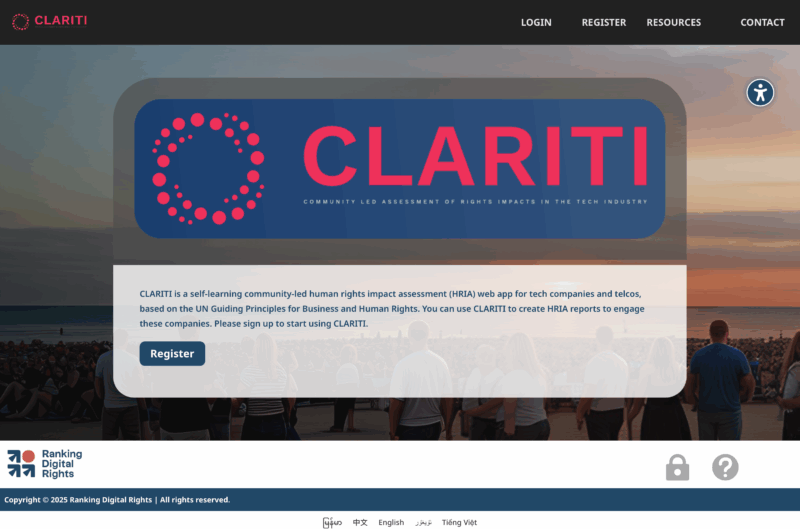
Anyone can use CLARITI to conduct a Human Rights Impact Assessment (HRIA) grounded in the UN Guiding Principles on Business and Human Rights (UNGPs) to hold companies accountable through constructive engagement. CLARITI is designed with step-by-step instructions that make the process less intimidating for any newcomers to HRIAs, inspiring a learn-as-you-go experience. CLARITI walks you through the process, providing explanations and recommendations, so you don’t feel lost at any point. This makes generating a comprehensive and customised HRIA report faster and easier than with other HRIA methodologies.

Besides English, CLARITI is also available in the following languages: Burmese, Chinese, Uyghur, and Vietnamese.

CLARITI was created by Ranking Digital Rights as part of the Engaging Tech for Internet Freedom (ETIF) programme. Development began in mid-2023, with a review of existing methodologies for conducting Human Rights Impact Assessments. While several tools exist, they are geared primarily towards governments or companies, to facilitate their internal HRIA or Human Rights Due Diligence processes.

We, therefore, identified a gap: a tool that can help local communities in holding the tech sector accountable. Through this review, we also found that existing tools could serve as a strong foundation for the development of CLARITI.

CLARITI was further enhanced by two pilot projects, conducted between June and September 2024, by NGOs representing the rights of Vietnamese and Chinese social media platform users, Legal Initiatives for Vietnam (LIV) and Human Rights in China (HRIC), respectively. To better meet the needs of the rightsholder representatives, the final design of CLARITI also draws upon the methodology review and feedback from these two pilots.

Each pilot project focused on one major social media service: Legal Initiatives for Vietnam conducted an assessment of Facebook, while Human Rights in China conducted an assessment of X, formerly Twitter. CLARITI served as the basis for the reports that both organisations published showcasing their findings.

Who is CLARITI designed for?

CLARITI is designed to be used by NGOs, journalists, researchers, academics and human rights advocates, i.e.: the people who hold digital platforms and telcos accountable for the rest of society. But ultimately, CLARITI benefits anyone who is an end user of the products and services of digital platforms and telcos.

While CLARITI can be applied to any country, it was designed with particular consideration for rights holders in authoritarian and semi-authoritarian contexts where rights violations tend to be the greatest, and where authoritarian regimes may compel tech companies to act in line with restrictive laws and regulations.

What makes CLARITI easy?

CLARITI combines the strength of existing community-led and company-led methodologies to deliver a user experience that is accessible, intuitive and as inclusive as possible. 

The CLARITI methodology includes eight phases to guide users through conducting a comprehensive HRIA.

  1. Phase 1 introduces CLARITI’s framework and alignment with the UN Guiding Principles (UNGPs).
  2. Phase 2 prepares the user by assembling the assessment team, defining objectives and planning logistics.
  3. Phase 3 helps users scope the assessment’s relevant sections based on stakeholder feedback and check that all preparatory steps from Phase 2 are complete.
  4. Phase 4 is a context analysis that focuses on understanding the broader country, industry and company environment in which human rights impacts occur
  5. Phase 5 is an impact assessment phase and involves answering relevant questions and scoring human rights impacts.
  6. Phase 6 is a recommendations phase that uses the analysis from previous phases to guide users in suggesting measures to mitigate and address identified implications for the company.
  7. Phase 7 is a reporting phase which helps users compile their findings and recommendations into a formal report.
  8. Phase 8 provides guidance to engage with companies and encourage positive change.

CLARITI is designed to be educational, allowing anyone with some research experience to use it, regardless of their experience conducting HRIAs. As shown in Figure [1], users are provided with extensive guidance and curated sources to help answer questions that analyse the context of the company’s operations and their impact on rights based on international human rights standards. These questions are tailored to the different contexts of the industry and country where the company operates, so that users logically identify relevant salient human rights impacts for a given situation and propose appropriate recommendations.
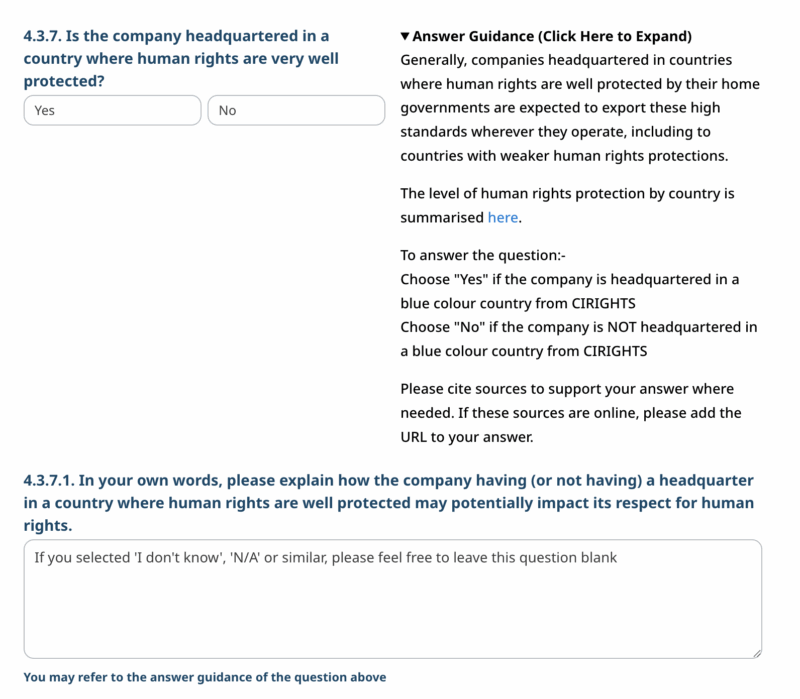
Figure 1: Example of a question with detailed answer guidance and a curated source to help users answer the questions comprehensively.

CLARITI is also designed to be scalable – users can select from any of the 11 impacts on rights to freedom of expression, privacy and non-discrimination that companies may cause, contribute or be linked to. For an HRIA that needs to assess a wide range of rights impacts, all 11 modules can be evaluated. At the same time, a more targeted HRIA (such as those that took place during the CLARITI pilots) might only require that one to two such modules be evaluated. Users may also complete additional modules later to augment their analysis and recommendations. 

This approach allows users to optimise between a comprehensive or targeted (i.e. issue-specific) HRIA at different points in time. As shown in the screenshot below (see Figure 2), users are only shown relevant impacts based on the type of company they have selected. For example, impacts on freedom of expression from government-ordered network disruptions are not shown for platform companies since this impact relates to telcos.
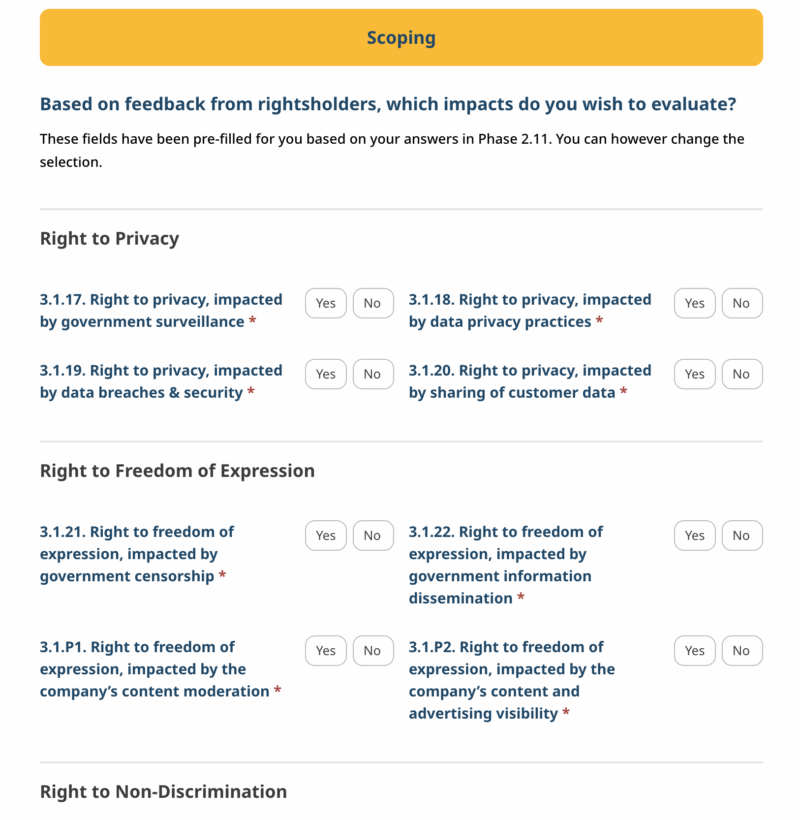
Figure 2: Users can choose which of 11 impacts to rights to freedom of expression, privacy and non-discrimination that they wish to assess using CLARITI.

The CLARITI methodology is designed to be intuitive and efficient. Outputs from preceding phases inform the inputs of subsequent phases, thereby creating a logical workflow that guides the inductive and deductive reasoning processes inherent to an HRIA. 

“Many people, myself included, have made strong claims about Facebook’s impact on human rights in Vietnam, particularly its effect on freedom of expression. CLARITI, however, enables us to examine this issue with much greater clarity and fairness. It brings an evidence-based approach that reduces exaggeration or understatement, and helps quantify the situation more accurately.”

~ Trịnh Hữu Long, Interim Executive Director, Legal Initiatives for Vietnam

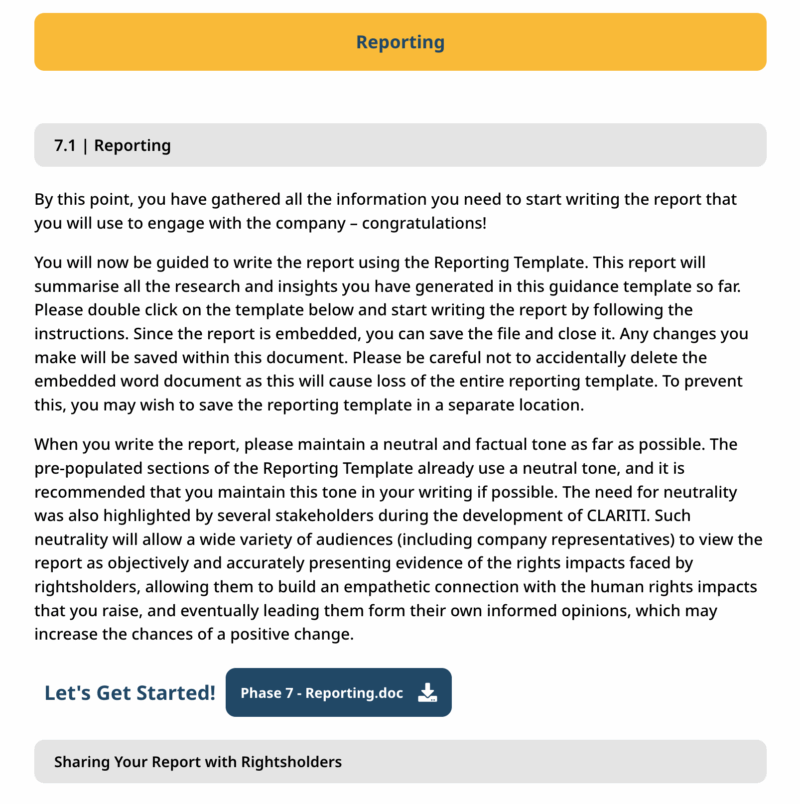
Furthermore, users are provided with ready-made templates to expedite the creation of graphs and reports. For example, the Phase 7 Reporting Template includes standard text describing the methodology users can leave unchanged. At the same time, guidance helps users paraphrase and import findings from the research completed in previous phases. A template in Phase 5 allows users to plot a graph that is later imported directly into the report of Phase 7, where it is used to prioritise rights impacts.
The CLARITI tool will be presented in-depth, together with the pilot experiences conducted by LIV and HIRC, at DRAPAC25, the Digital Rights in Asia-Pacific conference hosted this year in Kuala Lumpur, Malaysia during the session ‘Mission Invisible: How Collaboration Sparks Rights-Based Digital Change in Asia-Pacific based on Communities Feedback’ on Thursday 28th August, 2025.

**FOR IMMEDIATE RELEASE**


April 28, 2025

Amsterdam, 28 April 2025 — Despite growing threats to users’ rights online and the explosion of generative AI, the world’s largest tech giants are still failing to create the guardrails needed to protect the rights of billions of online users, according to the results of the 2025 Ranking Digital Rights (RDR) Index: Big Tech Edition, now part of the World Benchmarking Alliance.

RDR’s first evaluation of the world’s most powerful Big Tech platforms in three years reveals that companies are stagnating in fulfilling their key human rights commitments—and in some cases retreating from transparency entirely. The RDR Index evaluates, scores, and ranks companies on more than 300 aspects of company policies that affect people’s human rights, focusing on corporate governance, freedom of expression and information, and privacy.

With X (formerly Twitter) falling from its long-held top spot to seventh place, Microsoft took over as the company with the leading score in this assessment. However, Microsoft maintained the same overall score of 50% that it held in 2022. This is also the first year in which TikTok (and its parent company ByteDance) was included in the RDR assessment. Despite controversy surrounding U.S. government privacy concerns, the company scored near the middle of the pile.

“The collective power of supersized tech giants has never been greater,” said Dr. Jan Rydzak, Digital Transformation Lead at the World Benchmarking Alliance.

“The world’s largest digital platforms dominate entire industries and the infrastructure they rely on. Three of them control a staggering two-thirds of the online ad market – the deeply flawed engine that powers much of the internet today. Their algorithmic feeds have long influenced what we see, hear, and think. Now they are also awash in synthetic content that is causing social trust to unravel further.

The 2025 RDR Index: Big Tech Edition shows that power and accountability do not always go hand in hand, and human rights protections can easily crumble away. It serves as an anchor of truth in a time of widespread information chaos.”

For the third time in a row, no company scored above 50 percent. A majority of companies showed some improvement, particularly the Chinese tech giants, while two companies’ overall scores declined. Notably, U.S.-based Big Tech giants, representing five of the 10 companies with the highest market cap worldwide, have accrued enormous political power while skirting much-needed scrutiny. The incremental changes we’ve seen are insufficient given the urgent challenges to user rights online emanating from global conflict, worldwide democratic decline, and the unbridled growth of generative AI.

Other highlights from the 2025 RDR Index: Big Tech Edition include:

  • Driven by a regulatory crackdown on the tech sector by President Xi Jinping and pressure from international investors, Chinese companies are the most improved in key areas of transparency.  These companies, including Alibaba, Baidu, and Tencent, made the greatest progress overall, driven mostly by strong improvements in key areas of governance. Still, how they translate into practice remained unclear, as all three companies kept their long-held silence on government demands for content and account restrictions as well as user data.
  • Tech companies are training AI models on billions of users’ data, with no way for users to opt out. There have been overall improvements in algorithmic transparency since RDR first expanded its focus on it in the 2020 RDR Index. But the rapid proliferation of large language models calls for much more urgent action.
  • Companies are failing to protect users from key risks emanating from the surveillance advertising industry. Most companies are failing to conduct regular human rights impact assessments to identify how their processes for policy enforcement and targeted advertising policies impact users’ rights. Two have ceased to publish data on advertising policy enforcement altogether.
  • X’s precipitous transparency drop is the largest in RDR’s history.  X (formerly Twitter) recorded the most dramatic drop in performance of any company in the history of the RDR Index. Last assessed by RDR just before its acquisition by Elon Musk, the company has retreated from transparency, particularly on governance. This reversal is exceptionally relevant as X’s U.S.-based competitors adopt some of its practices, such as the use by Meta of Community Notes .
  • TikTok performed comparably to other U.S.-based platforms, though its strong performance on freedom of expression was tempered by exceptionally poor governance disclosures. TikTok’s results contrast with recent rhetoric in the U.S. that led to the suspension of its operations and a possible forced divestiture. TikTok outperformed all other companies in the freedom of expression category, buoyed by strong transparency reporting.

Every company we rank has its own scorecard that offers a detailed look at highlights from the past year, key takeaways, recommendations, and changes.


And, check out our Executive Summary.

Also new in the RDR Index: Big Tech Edition, our four key findings, which will be released on Thursday, May 1. You’ll be able to take a deep dive into year-over-year progress and decline, emerging risks and trends, and areas for concerns within the sector. These key findings will include:

  • “Three years on, U.S. tech giants are moving slow and not fixing things”: The trillion-dollar U.S. tech titans have dwarfed their competitors in size and power. But their quest for market dominance has paralyzed progress and widened the rift between commitment and practice.
  • “Why Chinese companies are racing to improve on transparency”: Chinese companies’ scores experienced a notable jump this year, driven by a regulatory crackdown and ESG concerns. But gaps remain in freedom of expression, and they still lag behind U.S. counterparts.
  • “Private platforms are falling short on transparent governance”: This year, RDR evaluated two private tech companies for the first time: X and and TikTok (ByteDance). While both performed comparably to others on privacy and freedom of expression, they lagged on governance transparency.
  • “User data fuels Big Tech’s algorithms, and there’s no opting out”: Big Tech giants are increasingly integrating AI into their algorithms to better target individual users of platforms and services. But improvements to algorithmic transparency are failing to keep up with growing risks to users.

           -ENDS-

For more information, please contact Forster Communications at WBAmedia@forster.co.uk or WBA at press@worldbenchmarkingalliance.org

Photo by ev on Unsplash.

In 2022, as part of our effort to expand corporate accountability in the Majority World under the auspices of the Greater Internet Freedom Consortium, we partnered with the Balkan Investigative Reporting Network (BIRN) to collaborate on a research project using the RDR Index methodology. BIRN studied the freedom of expression and privacy policies of 13 telecom operators in Albania, Bosnia and Herzegovina, Kosovo, North Macedonia, Moldova, and Serbia. The report, titled Hidden in Plain Sight, which includes the findings from all the countries, was published in June 2023.

BIRN’s research in Albania was carried out during a moment of tectonic shifts in the national telecommunications landscape. In 2022, two of the three major players were being acquired by one foreign company, with a plan to merge them into a single operator at the beginning of 2023.

The companies in question were ALBtelecom and ONE Telecommunications; both were bought by the Hungarian telecom and ICT juggernaut 4iG. BIRN evaluated these companies separately, as well as evaluating the third company, Vodafone Albania. This research set a baseline for understanding changes in policies and practices that may occur after the merger.

4iG has a special place in Hungary’s current political landscape. The company enjoys close ties with Prime Minister Orbán, who has been vying to exert even greater influence on the Balkans region. Orbán and his inner circle believe that expanding their control over the telecommunications sector allows them to collect information on a massive scale and stop their opponents from using the information networks against them. In fact, 4iG’s CEO has stated that his company sees significant growth potential in the Western Balkans and intends to increase their presence in the region. To that effect, over the past three years, 4iG has gone on a shopping spree of sorts. The company acquired Vodafone’s business unit in Hungary, as well as Telenor’s operations in Montenegro, later rebranding the subsidiary to ONE. 4iG just recently signed a memorandum with the government of North Macedonia confirming their intention to enter that market as well.

Early in 2024, BIRN conducted a followup assessment in Albania, to learn more about what took place after 4iG merged ALBtelecom and ONE Telecommunications under the new brand ONE Albania.

According to these most recent findings, the worrisome transparency gaps first uncovered in Hidden in Plain Sight remained. Neither Vodafone Albania nor ONE Albania disclosed any information about the process used to respond to government demands to restrict content or accounts and whether users are notified of restrictions to their accounts or content. The companies also lack the crucial transparency reporting needed to inform their users and the public about the volume and nature of the actions taken to restrict content that violates the companies’ rules, the number of demands received from government bodies (including judicial orders) to remove, filter, or restrict content and accounts, and government demands to share personal data from their users. Relatedly, neither company publicly commits to pushing back against potentially overreaching government demands.

ONE Albania made slight progress compared to its predecessors–ALBtelecom and One Telecom–on two privacy indicators assessing whether the company discloses what user information it shares and with whom, as well as why it collects, infers, and shares user information. On these indicators, ONE Albania disclosed some details about its data-sharing practices on the company’s Privacy Code. However, they remain superficial, using broad terminology, and leaving out details about the types of data that is shared. Neither Vodafone Albania nor ONE Albania provide any information about how they collect and share user information from third parties.

This research confirms what we at Ranking Digital Rights already know: Given their powerful position to both enable and undermine the enjoyment of human rights, telecommunication companies need to do better. And to ensure they do, we need greater accountability. In 2022, the same year this research was first conducted, my former colleague at RDR, Hungarian researcher Veszna Wessenauer, wrote about the Orbán government’s pursuit of ‘national ownership’, including of the telecom sector. In particular, she noted the risks inherent in the Hungarian state’s purchase, alongside government-aligned 4iG, of Vodafone Hungary. With the Hungarian government now bringing similar tactics into the Balkans, her call for a renewed focus on telcos and for the need for greater transparency, including on demands for shutdowns and the censoring of user content, continues to ring true, especially for companies operating under the reach of authoritarianism, whether from at home or abroad.

New America, Ranking Digital Rights, and World Benchmarking Alliance.


Over the past decade, Ranking Digital Rights (RDR), a corporate accountability program incubated at New America, has advanced transparency on digital rights among the world’s most powerful technology and telecommunications companies. Its benchmarking and research on companies’ policies and practices has been widely recognized as a gold standard on freedom of expression and privacy in the tech sector.

On January 1, 2024, RDR began the next chapter of its corporate accountability work with a transition to the World Benchmarking Alliance (WBA). This move will give RDR an opportunity to engage with a broader international coalition of benchmarking efforts driving systems change through the tools of corporate accountability. It will also serve as a new bridge between New America and the World Benchmarking Alliance under our shared vision of advancing a more inclusive and sustainable digital future.

Over the last decade, while at New America, Ranking Digital Rights laid the bedrock for corporate accountability in the information and communications technology (ICT) sector by demanding transparency from Big Tech and Telco Giants. It has exerted pressure on the most powerful of these companies to uphold their obligations to respect and promote human rights, and at the same time galvanized others — from lawmakers to civil society to activist investors — to use the data and insights and grow the global movement for tech accountability.

RDR is joining WBA, widely recognized as the home of sustainability-focused benchmarking. Since 2018, it has built a movement to hold 2,000 of the world’s most influential companies accountable for their part in achieving the UN Sustainable Development Goals (SDGs). Its benchmarks reflect the breadth of the commitments and changes that companies must make to put our planet, society, and economy on a more sustainable and resilient path.

RDR will continue to advance and further shape its mission under WBA’s Digital Transformation, one of seven systems in which the organization has identified the need for companies to take urgent action to achieve the SDGs. RDR’s flagship Corporate Accountability Index and Scorecards will dovetail with the Digital Inclusion Benchmark (DIB), which has successfully set the standard for what corporations should do to advance a more inclusive digital society. Across three iterations to date, it has charted the progress of 200 technology companies toward achieving that goal, calling them out when they fall short.

Similarly, New America will continue to build out its corporate accountability work scrutinizing the systems and investment culture that ‘moves fast and breaks things,’ that unleashes new technologies and leaves society and democracy to deal with the consequences. WBA, RDR, and New America hold a shared ambition to support a stronger benchmarking community that recognizes how societal challenges intersect and interact around the world.

As such, New America will also join WBA’s community of Allies – a collective of nearly 400 organizations exchanging insights on the research, data, and strategies we need to better hold the private sector accountable. Through its Technology & Democracy programs, New America brings an unparalleled understanding of the tech policy space in the U.S. and beyond, galvanizing lawmakers to shape regulations in a way that contributes to a stronger society.

Together we look forward to helping build a sustainable digital future that works for everyone.


About New America

We are dedicated to renewing the promise of America by continuing the quest to realize our nation’s highest ideals, honestly confronting the challenges caused by rapid technological and social change, and seizing the opportunities those changes create.
Our technology and democracy programs work towards a sustainable, digital future that advances equitable opportunity, innovation, fundamental rights and participatory governance.

About Ranking Digital Rights

Ranking Digital Rights (RDR) is an initiative that promotes freedom of expression and privacy on the internet by creating global standards and incentives for companies to respect and protect users’ rights. It evaluates the world’s largest digital platforms and telecommunications companies through the RDR Corporate Accountability Index (RDR Index) and Scorecards. We work extensively with investors and civil society groups seeking to hold technology companies accountable.

About the World Benchmarking Alliance

The World Benchmarking Alliance (WBA) is a non-profit organisation holding 2,000 of the world’s most influential companies accountable for their part in achieving the Sustainable Development Goals. It does this by publishing free and publicly available benchmarks on their performance.